
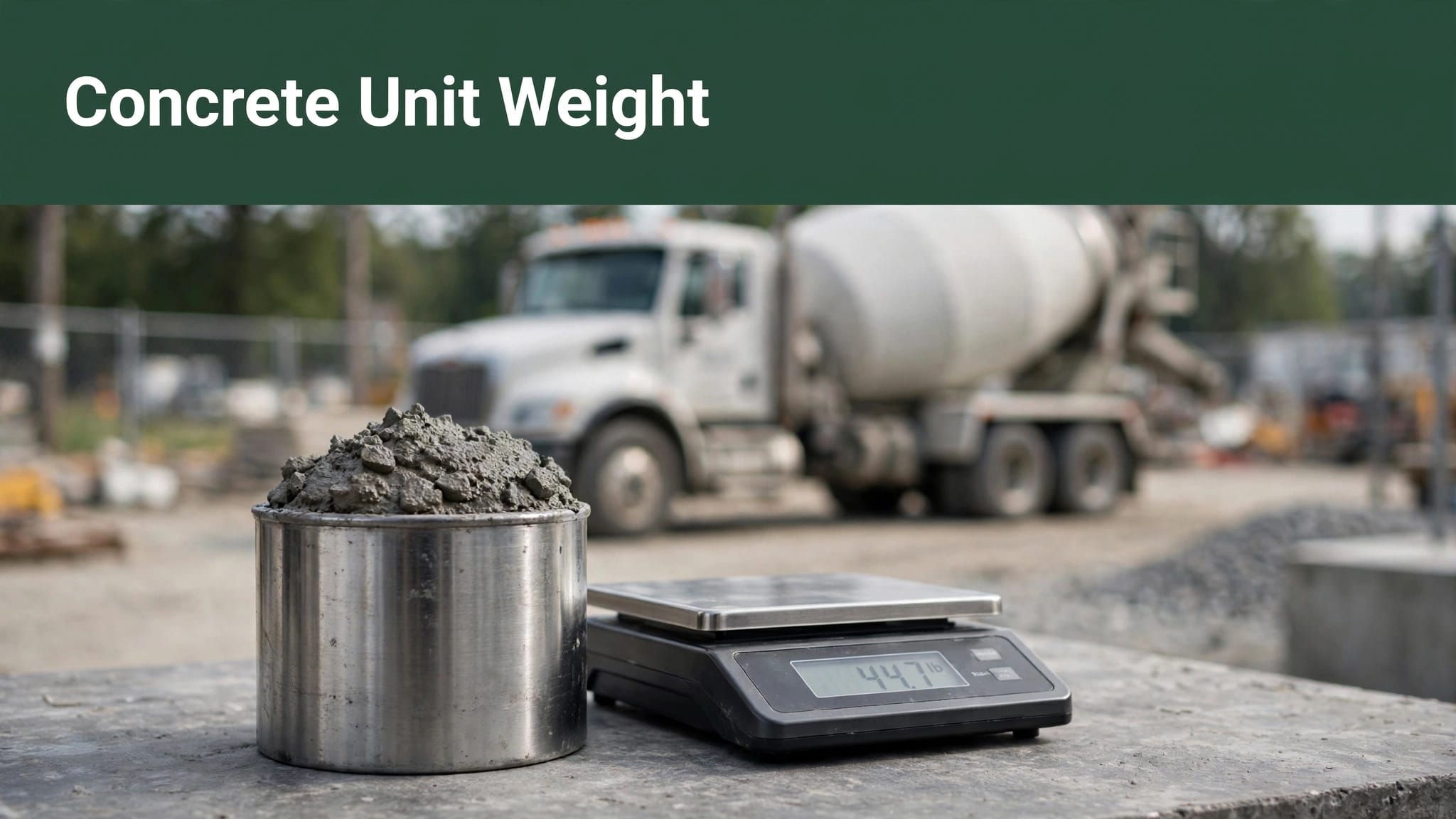
A ready-mix load can look workable without telling you how much concrete each cubic foot contains. Concrete unit weight testing measures fresh concrete density, helping check mixture consistency and calculate yield when batch information is available.
For Charleston homeowners and businesses, that reading belongs alongside the approved mix, delivery ticket, and site checks. A passing density result doesn’t prove strength or correct poor preparation.
Start with what the test measures, then connect the result to the concrete being placed.
Key Takeaways
- ASTM C138/C138M measures fresh concrete density, commonly called unit weight, using a calibrated container and a scale.
- Density supports yield calculations, but it doesn’t independently establish compressive strength, durability, or delivered quantity.
- The approved mixture and project specifications provide context for the result. A Charleston address doesn’t create a universal density target.
- Testing responsibilities, documentation, and the response to an unexpected reading should be settled before placement.
What Concrete Unit Weight Testing Measures
Unit weight describes the mass of concrete within a known volume. Field reports commonly express it in pounds per cubic foot (lb/ft³) or kilograms per cubic meter (kg/m³).
The ASTM C138/C138M test method covers fresh concrete density and calculations for yield and gravimetric air content. The testing professional should follow the edition required by the project.
Density Starts With a Known Volume
The calculation is straightforward:
Density = (filled measure mass minus empty measure mass) ÷ calibrated measure volume.
Subtracting the container’s mass leaves the mass of the concrete sample. Dividing by its calibrated volume produces density.
However, an ordinary bucket with an estimated capacity isn’t an acceptable substitute. Equipment selection, calibration, consolidation, and strike-off affect the result. The procedure needs controlled measurements, even though the arithmetic is simple.
Yield Requires Batch Information
Yield is the volume of concrete produced by a batch. Calculating it requires the total batch mass and the measured fresh density.
Because one cubic yard contains 27 cubic feet, calculations must keep units consistent before comparing yield with an order expressed in cubic yards.
Gravimetric air calculations need additional mixture information, including ingredient quantities and specific gravities. Weighing a sample alone doesn’t provide everything needed to calculate its air content.
How Technicians Test Charleston Ready-Mix Loads
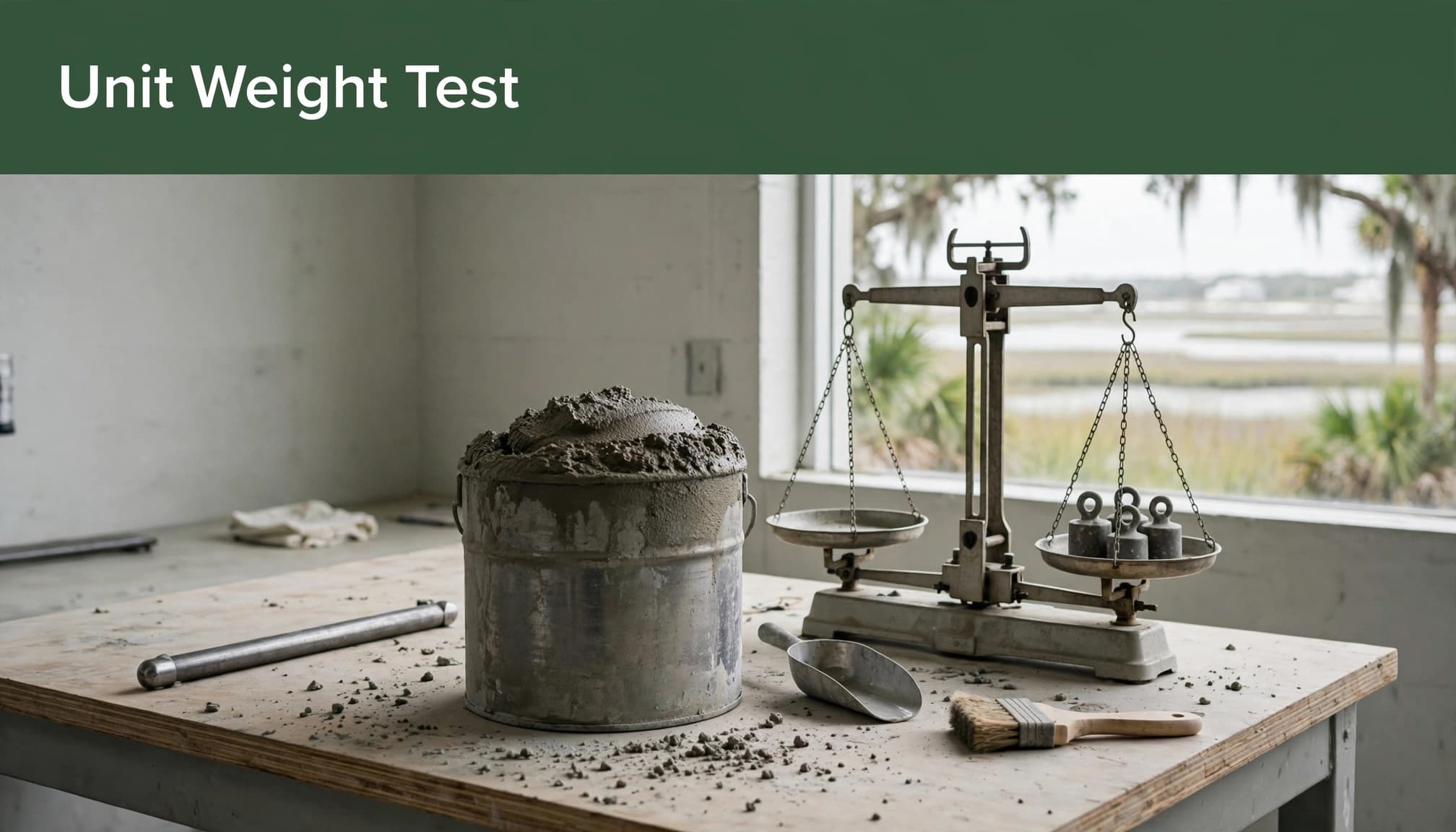
A useful result starts with a sample that represents the concrete being placed. Testing a dried scoop or separated material from the ground won’t provide that check.
Sample the Load Correctly
ASTM C172/C172M governs sampling freshly mixed concrete. It’s part of ASTM’s construction standards collection, alongside the methods used for individual fresh-concrete tests.
The technician should coordinate sampling with the delivery and placement plan. Required sampling locations and procedures matter, particularly when concrete passes through placement equipment.
Records should connect the sample to the truck, batch ticket, mix identification, and placement area. Otherwise, even an accurate reading may be difficult to trace when several trucks supply one slab.
Consolidate, Strike Off, and Weigh
The technician fills a suitable measure and consolidates the concrete using the method required for that sample. Depending on the governing procedure and concrete consistency, consolidation involves rodding or vibration.
Next, the technician strikes off the surface, cleans concrete from the container’s exterior, and weighs the filled measure. The C138 procedure guide from SI Certs describes these measurement steps.
Poor consolidation can leave extra voids and lower the measured density. Meanwhile, concrete stuck outside the container adds mass without adding to its calibrated volume. Both errors can distort the result.
Read Density and Yield Without Jumping to Conclusions
A density reading needs comparison with the approved mixture and available batch information. Different ingredients and air contents can produce different densities, so one generic number can’t judge every load.
Investigate an Unexpected Reading
If density differs from expectations, the testing professional should first review the sample, equipment, calculation, and test execution.
Then the contractor and supplier can review mixture identification, aggregate changes, air content, and documented adjustments. Gorilla Concrete’s guidance on concrete batch ticket checks explains how delivery records support that review.
A lower reading alone doesn’t prove unauthorized water addition. Likewise, a higher reading doesn’t automatically mean stronger concrete. Several material and procedural factors can influence density, and the responsible professional needs to evaluate them together.
Separate Yield From Finished Thickness
A yield calculation helps evaluate batch volume. It doesn’t measure the thickness of your completed driveway or slab.
Actual concrete demand depends on formed dimensions, thickened edges, uneven excavation, and other approved details. Therefore, a quantity concern calls for reviewing both production records and the placement area.
A density result alone can’t establish a short delivery. Yield review needs batch mass, and a shortage review also needs the actual placement dimensions.
Keep tickets and test reports organized by load and placement location. Those records are more useful than recollections after the surface has hardened.
Unit Weight Belongs Beside Other Concrete Tests
Fresh concrete testing answers several separate questions. ASTM’s concrete testing materials identify distinct procedures for sampling, density, slump, air content, temperature, and specimen preparation.
These checks provide different information.
| Check | What it measures | What it doesn’t establish |
|---|---|---|
| Unit weight, ASTM C138 | Fresh concrete density | Compressive strength |
| Slump, ASTM C143 | Fresh concrete consistency | Long-term durability |
| Temperature, ASTM C1064 | Fresh concrete temperature | Remaining finishing time by itself |
| Air, ASTM C231 or C173 | Fresh concrete air content | Individual air-void size and distribution |
| Compression, ASTM C39 | Strength of hardened test specimens | Quality of every part of the placement |
The testing plan determines which checks apply and how the results affect acceptance.
For example, air-content testing for Charleston concrete requires a method suited to the actual aggregate. Density doesn’t replace that required field test.
Similarly, strength evaluation depends on properly sampled, made, cured, and tested specimens. A fresh density measurement can’t establish the strength that concrete will develop later.
Match the Testing Plan to Your Charleston Project

The concrete’s intended use matters more than applying the same testing plan to every property. Structural elements and residential decorative surfaces can have different specifications.
Driveways and Structural Slabs
A concrete driveway in Charleston, SC, needs support suited to vehicle traffic, suitable thickness, drainage, and planned joints. Unit weight checks the fresh mixture, while site preparation addresses conditions beneath it.
For concrete slab installation in Charleston, the plans may also specify testing for structural loads, foundations, or commercial use. Confirm those requirements before ordering concrete.
When strength results affect acceptance, concrete compressive strength testing requires its own sampling and specimen-handling plan. Neither the ticket’s specified strength nor a density reading proves that the delivered load has already achieved that strength.
Stamped Patios, Pool Decks, and Tabby
A stamped concrete patio in Charleston needs consistent materials and finishing timing. Unit weight provides no direct measurement of color consistency or stamp quality.
Charleston pool-deck concrete also needs planned slopes, appropriate texture, and curing protection. A passing field test can’t correct ponding water or poor surface finishing.
For tabby concrete in Charleston, confirm how oyster shells enter the work. Surface-applied shells don’t automatically describe the aggregate throughout the mixture. Testing should match the actual concrete, while shell appearance and weather protection remain separate placement concerns.
Settle Testing Responsibilities Before the Truck Arrives
Ask your concrete contractor in Charleston, SC, whether the project calls for concrete unit weight testing. If it does, identify who performs it, who receives the report, and who has authority to evaluate an unexpected result.
Agree on Documentation and Decisions
The testing plan should identify the required methods, testing frequency, and any project-specific acceptance criteria. Don’t assume every residential load needs the same tests.
Also clarify whether testing is included in the contract or arranged separately. Reports should record the result, units, load identification, and relevant placement details.
If a reading falls outside an established limit, the contractor, supplier, and responsible testing professional need an agreed response. That may include checking the procedure and reviewing the mixture before deciding how to proceed. Homeowners shouldn’t have to make technical acceptance decisions while concrete is being spread.
Keep the Site and Weather Plan Ready
A Lowcountry concrete contractor should review soft spots, wet fill, drainage, reinforcement supports, forms, and required inspections before delivery.
Charleston heat, direct sun, and coastal wind can affect the working window. Humidity doesn’t prevent concrete from setting, and rainfall can change prepared ground conditions.
Testing needs coordination with truck access, placing crews, and finishing work. Meanwhile, curing protection must be ready before placement begins. Even accurate test results can’t compensate for an unstable base, interrupted placement, or concrete left without appropriate curing.
Frequently Asked Questions
Does every Charleston ready-mix load require unit weight testing?
Requirements depend on the project specifications and testing plan. Don’t assume a citywide requirement for every residential truck. Ask the contractor which tests apply to your work and how frequently they will be performed.
Can unit weight testing show that concrete is strong enough?
It measures fresh density. Compressive strength requires a separate evaluation using properly prepared and cured specimens tested at the specified ages. Density can support mixture review, but it doesn’t establish an achieved strength.
What should happen when a reading looks wrong?
The testing professional should check sampling, equipment, procedure, and arithmetic. Next, the responsible parties should compare the result with the approved mixture and batch records. Any further testing or acceptance decision should follow the project’s established process.
Can a good reading prevent cracking?
A satisfactory density result doesn’t guarantee crack-free concrete. Support, thickness, joints, reinforcement where specified, placement, and curing still affect performance.
A Better Pour Starts With Connected Checks
Concrete unit weight testing provides useful information when the sample, procedure, and batch records match the load being placed. Its value depends on clear documentation and a testing plan suited to the project.
Pair that measurement with sound preparation, appropriate companion tests, and controlled placement and curing.
For a Charleston driveway, patio, pool deck, or slab, Get a Free Quote to discuss the site, intended use, and quality checks before delivery day.

