
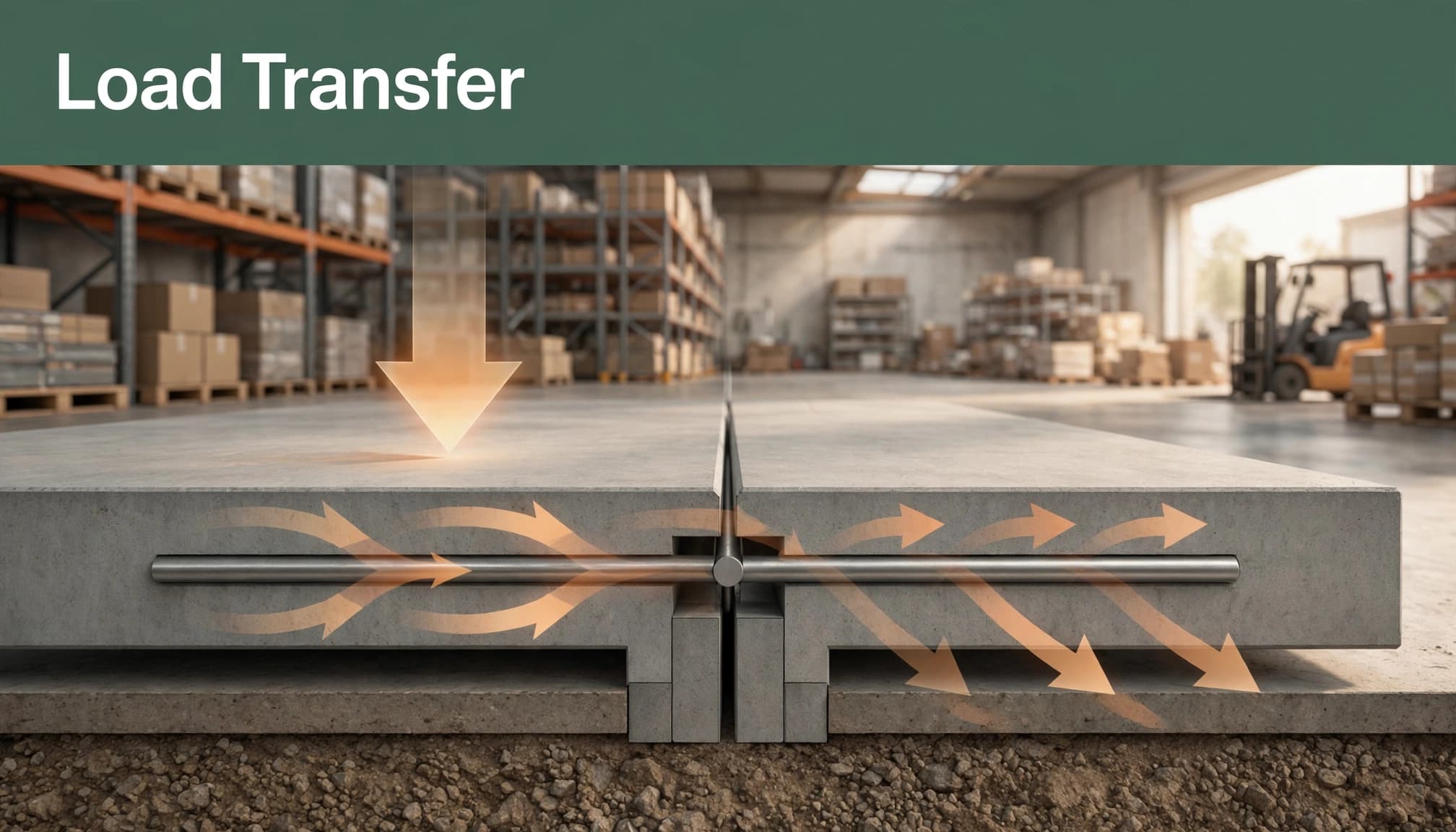
Concrete dowel bars transfer wheel loads across slab joints while allowing adjacent concrete panels to move as they shrink or change temperature. In a Charleston warehouse, that load transfer helps limit uneven movement where forklifts repeatedly cross the floor.
A durable warehouse slab also depends on stable ground, planned joints, and proper curing. The starting point is understanding what dowels can do, then coordinating them with the rest of the floor.
Key Takeaways
- Dowels share loads between adjoining slab panels without locking the joint against its intended movement.
- Forklift routes and repeated wheel crossings deserve attention when planning warehouse floor joints.
- Correct placement, concrete cover, and corrosion protection matter as much as including dowels.
- A load-transfer connection cannot correct weak soil, washout, or inadequate slab support.
How Concrete Dowel Bars Transfer Warehouse Loads
Sharing the load at a joint
When a forklift wheel approaches a joint, it loads the edge of one concrete panel. Without adequate load transfer, that edge can deflect differently from the adjoining panel.
A dowel crosses the joint and transfers part of the force into the neighboring concrete. Both panels then participate in carrying the wheel load.
This matters because warehouse traffic repeats the same movements. A joint along a busy aisle may experience frequent crossings, braking, and turning. Small differences in panel movement can contribute to edge deterioration over time.
Allowing concrete to move
Concrete joints also need room to open and close. Drying shrinkage and temperature changes create movement even when the floor looks unchanged.
The FHWA guidance on concrete joints describes the dowel’s purpose as transferring loads without restricting joint opening and closing. That distinction matters: a load-transfer detail must support the panels while preserving the movement intended by the design.
A connection that restrains that movement can create stresses elsewhere in the slab. Simply adding more steel doesn’t necessarily improve the joint.
Match Load Transfer to the Joint’s Purpose
Construction joints separate placements
Construction joints occur where one concrete placement ends and another begins. Warehouse floor plans should establish these locations before placement starts, rather than leaving them entirely to daily production decisions.
Where equipment will cross these boundaries, the joint needs a deliberate load-transfer detail. The American Concrete Institute’s floor and slab construction guidance recommends doweled construction and contraction joints when load transfer is required.
The location matters alongside the connection itself. A joint through a heavily traveled turning area faces different demands than one outside the main operating route.
Contraction and isolation joints serve different jobs
Contraction joints create planned locations for shrinkage cracking. Depending on the floor design and loading, they may also need mechanical load transfer.
Isolation joints separate a slab from elements such as columns or walls so those components can move independently. Carrying a dowel detail across an isolation boundary without design direction can defeat that purpose.
For owners, the practical distinction is straightforward: joint details aren’t interchangeable. The drawings should identify each joint’s function, its load-transfer connection where needed, and how it relates to surrounding building elements.
Placement and Corrosion Protection Matter
Alignment must preserve joint movement
A dowel can be present and still perform poorly if its position prevents the intended movement. Alignment, support during placement, and the relationship between the bars and joint location all matter.
Concrete placement can disturb unsecured components. Therefore, the crew needs a stable installation arrangement and a clear joint layout before the pour begins.
FHWA’s dowel placement evaluation report also identifies risks associated with inadequate concrete cover, including corrosion and spalling. Placement quality affects both the immediate load-transfer function and the surrounding concrete’s durability.
Protect the complete bar
Corrosion protection deserves attention throughout the dowel, including its ends. FHWA’s concrete pavement rehabilitation guidance identifies that requirement and describes round dowels as a commonly used retrofit load-transfer device.
For warehouse work, the specified protection needs to survive handling and installation. Damage that exposes steel shouldn’t disappear into the pour without attention.
Protection also has to remain compatible with the joint’s intended movement. A detail that protects steel but prevents the connection from moving as designed creates another problem. The complete installation needs to follow the floor’s engineered joint detail.
Charleston Slab Planning Starts Below the Surface

Prepare support before specifying the connection
For concrete slab installation in Charleston, subgrade preparation belongs in the same conversation as joints and reinforcement. Disturbed fill, wet areas, and changes in soil across a property can create uneven support.
A dowel transfers force between panels; it doesn’t improve the soil beneath them. Unsuitable material, poor compaction, and erosion need their own solutions before concrete placement.
The same principle applies to a concrete driveway in Charleston, SC. However, warehouse equipment and operating patterns require a floor design suited to commercial use.
Coordinate drainage, placement, and curing
Water management helps protect the support around the slab. Exterior grades and loading-area drainage should keep runoff from repeatedly concentrating at vulnerable edges.
During placement, Charleston’s humidity doesn’t eliminate moisture-loss concerns. Sun, warm concrete, and wind can shorten the finishing window. Proper curing remains necessary after finishing, even when the surrounding air feels damp.
As a Lowcountry concrete contractor, we provide commercial concrete services in Charleston, including warehouse floors, loading areas, and site slabs. Those connected surfaces need coordinated planning because traffic and drainage often cross the boundaries between them.
Plan the Floor Around Warehouse Operations
Warehouse floor planning should start with actual use. Forklift routes, wheel types, turning areas, and storage arrangements help establish where the floor will experience concentrated demand.
Rack posts also create concentrated loads, but they differ from moving wheel loads. Both belong in the slab design. A clear equipment layout helps the designer coordinate joint locations with aisle traffic and rack arrangements.
Before placement, the project team should settle the following operating details:
- Map routine travel paths, including turns and approaches to loading areas.
- Identify rack layouts and equipment locations that affect slab loading.
- Coordinate placement boundaries with access requirements and the construction schedule.
Curing and opening to traffic require their own plan. A floor that looks finished isn’t automatically ready for loaded forklifts or rack installation.
Strength requirements should govern loading decisions. Concrete maturity testing, when properly established for the mix, can help estimate in-place strength. However, that estimate doesn’t establish correct slab thickness, sound support, or adequate joint construction.
Diagnose Joint Damage Before Choosing a Repair
A chipped joint edge doesn’t automatically mean the dowels failed. Uneven support, slab curling, repeated impact, or deterioration of the surrounding concrete can produce similar visible damage.
The repair should address the cause. Surface patching may restore an edge, but it won’t correct a moving panel or a void beneath the slab. Likewise, filling a joint doesn’t automatically restore mechanical load transfer.
A joint filler can support vulnerable edges, but it doesn’t replace a missing dowel connection beneath the surface.
Existing floors may be candidates for engineered dowel retrofits. However, the surrounding concrete must be suitable for the proposed repair, and underlying support problems need attention.
For warehouse owners, recurring damage in the same wheel path deserves investigation. An engineer or qualified concrete repair professional can distinguish a localized edge problem from a broader slab issue.
Separate Floor Finish Choices From Structural Needs
Warehouse floors need a surface suited to equipment traffic and the building’s use. Decorative choices belong to a different part of the decision.
A stamped concrete patio in Charleston may emphasize pattern and color. Pool deck concrete needs dependable drainage and an appropriate walking texture. Tabby concrete adds oyster-shell character to Charleston properties. None of those finishes determines whether a warehouse joint needs load transfer.
That separation helps when one property includes several types of flatwork. The office entrance, outdoor employee area, and warehouse floor can have different finishes while still requiring sound preparation beneath each surface.
For the warehouse itself, choose the joint system around movement and loading. Then coordinate the finish, curing method, and any floor treatment with those requirements. A good-looking surface cannot compensate for an unsuitable connection between panels.
Frequently Asked Questions
Do concrete dowel bars prevent all slab cracks?
Dowels help transfer loads across planned joints. They don’t eliminate drying shrinkage, prevent every crack, or compensate for poor curing.
Other reinforcement may help control crack widths, depending on the design. However, reinforcement and dowels have different jobs. A warehouse floor needs a coordinated system rather than one component expected to solve every problem.
Does a cracked warehouse joint always need replacement?
Replacement isn’t automatic. The decision depends on the condition of the concrete, the amount of movement, and whether the panels retain adequate support.
Localized edge damage may allow a targeted repair. Deeper cracking, settlement, exposed steel, or recurring movement calls for professional assessment before selecting a repair method. Covering the damage without addressing its cause can lead to another failure.
Are dowel bars the same as reinforcing bars?
Smooth dowels and deformed reinforcing bars behave differently. Deformed bars bond to concrete along their surface, while a doweled joint detail allows the movement required by its design.
Substituting ordinary reinforcing bars for specified dowels can change how the joint behaves. The project’s joint detail should control the installation.
Build Load Transfer Into the Whole Slab
Concrete dowel bars work best as part of a coordinated warehouse floor system. Their value depends on correct joint details and placement, backed by stable support beneath the concrete.
For a new warehouse floor or a damaged joint, we can discuss the concrete work your Charleston property needs. Get a Free Quote to start planning the project around its intended use.