
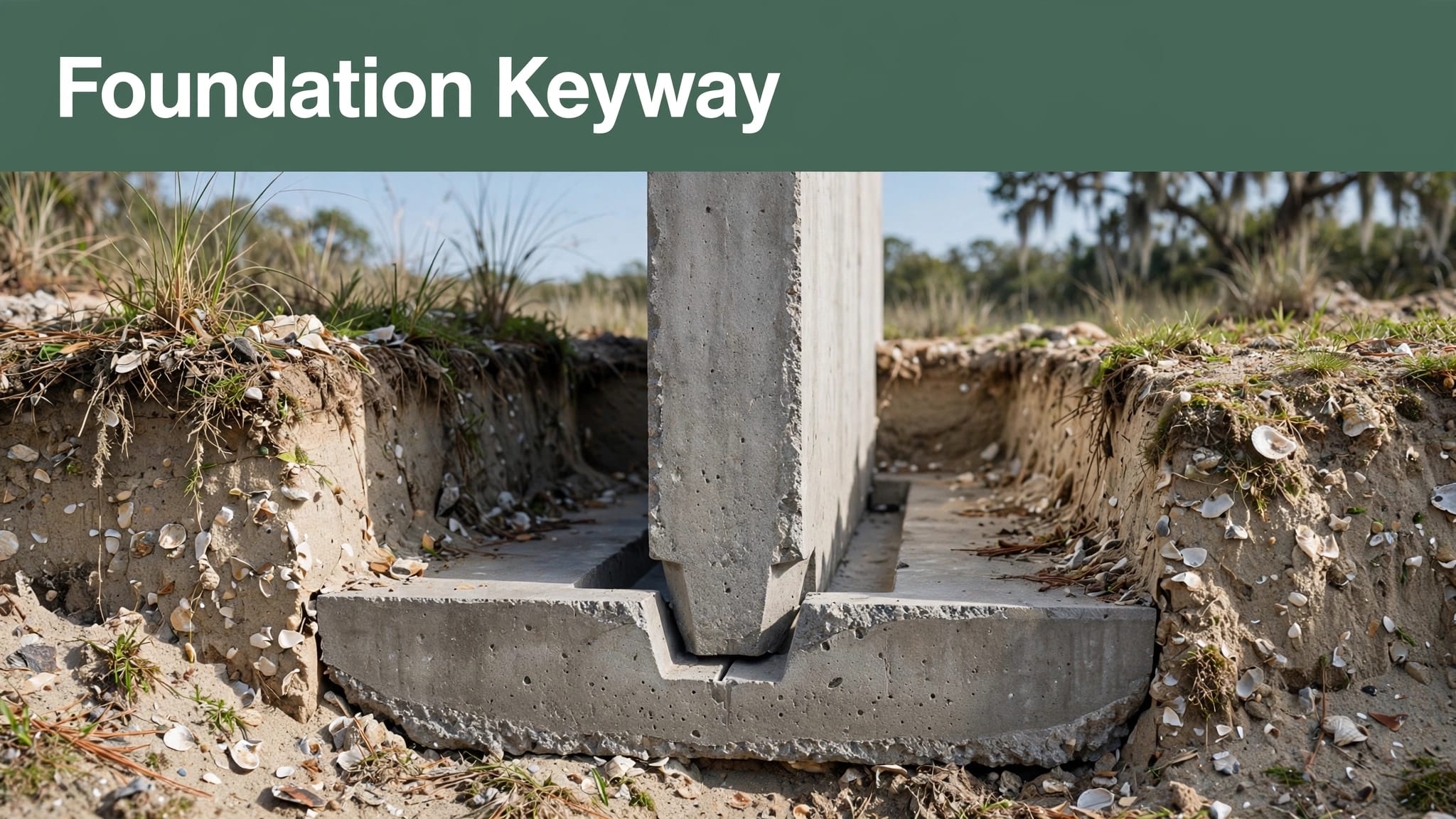
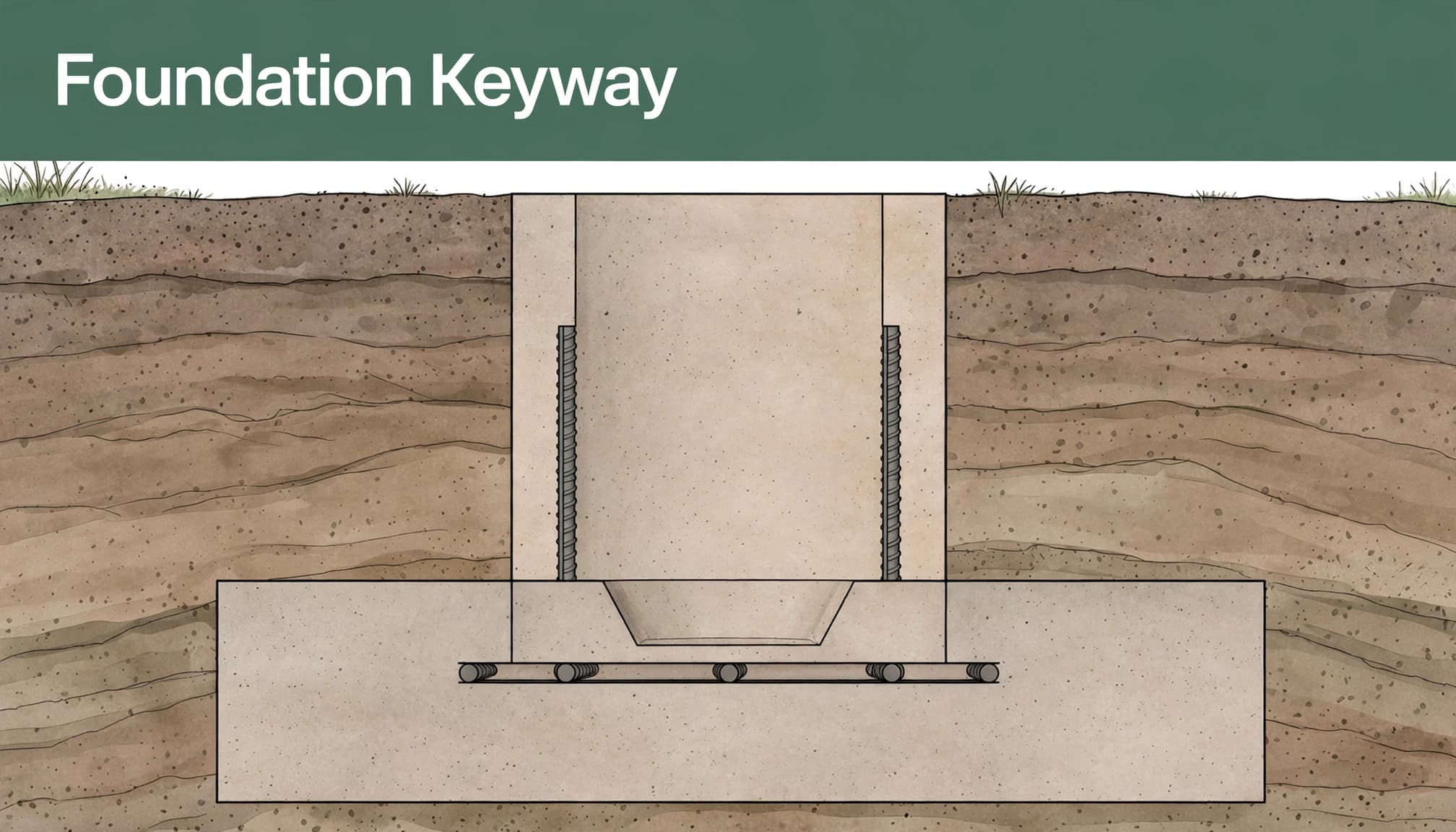
A concrete foundation keyway is a recessed groove at a planned joint between separate concrete placements. At a footing-to-wall connection, it provides a mechanical interlock that can help resist sliding when included in the structural design.
If you’re reviewing foundation plans for a Charleston home or commercial building, that groove has a specific job. It doesn’t replace reinforcement, drainage, or soil support. Start by understanding which joint you’re looking at and what it must do.
Key Takeaways
- A keyway provides mechanical interlock where the foundation design calls for it.
- Control joints and isolation joints perform different jobs.
- The groove doesn’t waterproof concrete or correct poor soil support.
- Foundation connections need coordinated structural and moisture-control details.
How a Concrete Foundation Keyway Works
Where separate placements meet
A footing and the wall above it may be separate placements. Their meeting surface is a construction joint, which needs a connection suited to the loads it carries.
The footing spreads building loads onto supporting soil. At its connection to a wall, the design may also need to address lateral forces. A keyway concerns the joint between those elements, rather than the bearing capacity underneath them.
The keyway gives that interface an interlocking profile. ACI’s guidance on concrete joints identifies wall-to-footing construction joints as a common application.
The important question is how the entire connection resists the forces acting on it. The presence of a groove alone doesn’t establish the joint’s capacity. Once both placements are complete, the joint geometry is largely hidden, so the finished wall doesn’t reveal every connection detail.
What the groove cannot do
A keyway can’t stabilize unsuitable fill, stop an entire footing from settling, or make a joint watertight. Those problems need separate solutions.
Reinforcement and moisture protection still need their own design. If a wall has moved or the joint is leaking, adding a groove isn’t a repair plan. A structural engineer should evaluate movement that raises foundation safety concerns.
Why Other Concrete Joints Work Differently
Control and isolation joints
On a concrete driveway in Charleston, SC, control joints create planned weak planes to help manage shrinkage cracking. Isolation joints provide full-depth separation where concrete meets elements that need independent movement.
A keyway has a different purpose because it interlocks adjoining placements rather than separating them. Connecting every new slab rigidly to a building can introduce restraint where movement should be allowed.
Keyed floor joints have limitations
Foundation details shouldn’t be copied automatically into floor slabs. In its guide to floor and slab construction, the American Concrete Institute warns that keyed joints aren’t recommended where load transfer is required. Drying shrinkage can open the joint until the keyway faces lose contact.
That warning concerns floor and slab joints. It doesn’t erase the separate use of keyways in wall-to-footing connections. The structural application matters more than the shared name.
What Matters on Charleston Foundation Projects
Ground support and water management
Lowcountry sites can include disturbed fill, wet areas, and changing soil conditions across one property. A keyway can’t compensate for inadequate bearing support or water that undermines the foundation.
Before concrete slab installation in Charleston, subgrade preparation and drainage need their own place in the construction plan. Likewise, a foundation joint may require a designed water-control system; mechanical interlock alone doesn’t stop leakage.
For additions, the relationship between new and existing foundations also matters. A new wall beside an older foundation doesn’t automatically call for a keyed connection. The engineer must account for the existing structure and how the new work will behave.
As a Lowcountry concrete contractor, we provide concrete slabs and foundations in Charleston for residential and light commercial projects. The connection detail needs to fit the building and site.
Nearby hardscape needs separate details
A stamped concrete patio in Charleston needs a joint layout coordinated with the finished pattern. The pattern itself doesn’t determine whether a foundation connection needs a keyway.
Pool-deck concrete in Charleston also needs slope, drainage, and suitable separation at adjoining elements. Meanwhile, oyster-shell tabby concrete brings a local finish option, but its appearance doesn’t change the structural job beneath it.
A Planned Joint Differs From a Cold Joint
Construction joints are intentional breaks between concrete placements. A cold joint develops when earlier concrete stiffens before the next placement can properly blend with it. The resulting interface may affect appearance, water resistance, or structural performance.
A formed keyway is part of a planned connection. An accidental seam isn’t equivalent, even if it happens near the same location.
Charleston heat, rain, and delivery interruptions make placement planning important. Our concrete foundation and slab resources cover related concerns, including cold joints, isolation joints, and waterproofing before backfill.
Frequently Asked Questions
Does every Charleston foundation need a keyway?
Keyways aren’t necessary at every foundation joint. The structural design determines whether one belongs at a particular connection. A monolithic placement doesn’t have the same interface as a separately placed footing and wall.
Does a keyway replace reinforcing steel?
Concrete interlock and reinforcing steel have different roles within a designed connection. The presence of a keyway doesn’t justify leaving out specified reinforcement or changing the foundation design.
Can a keyway stop foundation leaks?
A keyway alone isn’t a waterproofing system. Water management may involve drainage, exterior waterproofing, or a designed joint-waterproofing detail. The right combination depends on the foundation and its exposure to moisture.
A Sound Foundation Needs the Complete Connection
A concrete foundation keyway helps a designed joint resist relative movement between separate placements. Its performance depends on the complete connection, while soil support and water management require their own solutions.
For Charleston homes and businesses, plan the connection before the pour rather than treating a visible groove as proof of a sound foundation. The right detail belongs to the structure it supports.
To discuss your foundation or slab project, Get a Free Quote for your home or business.

