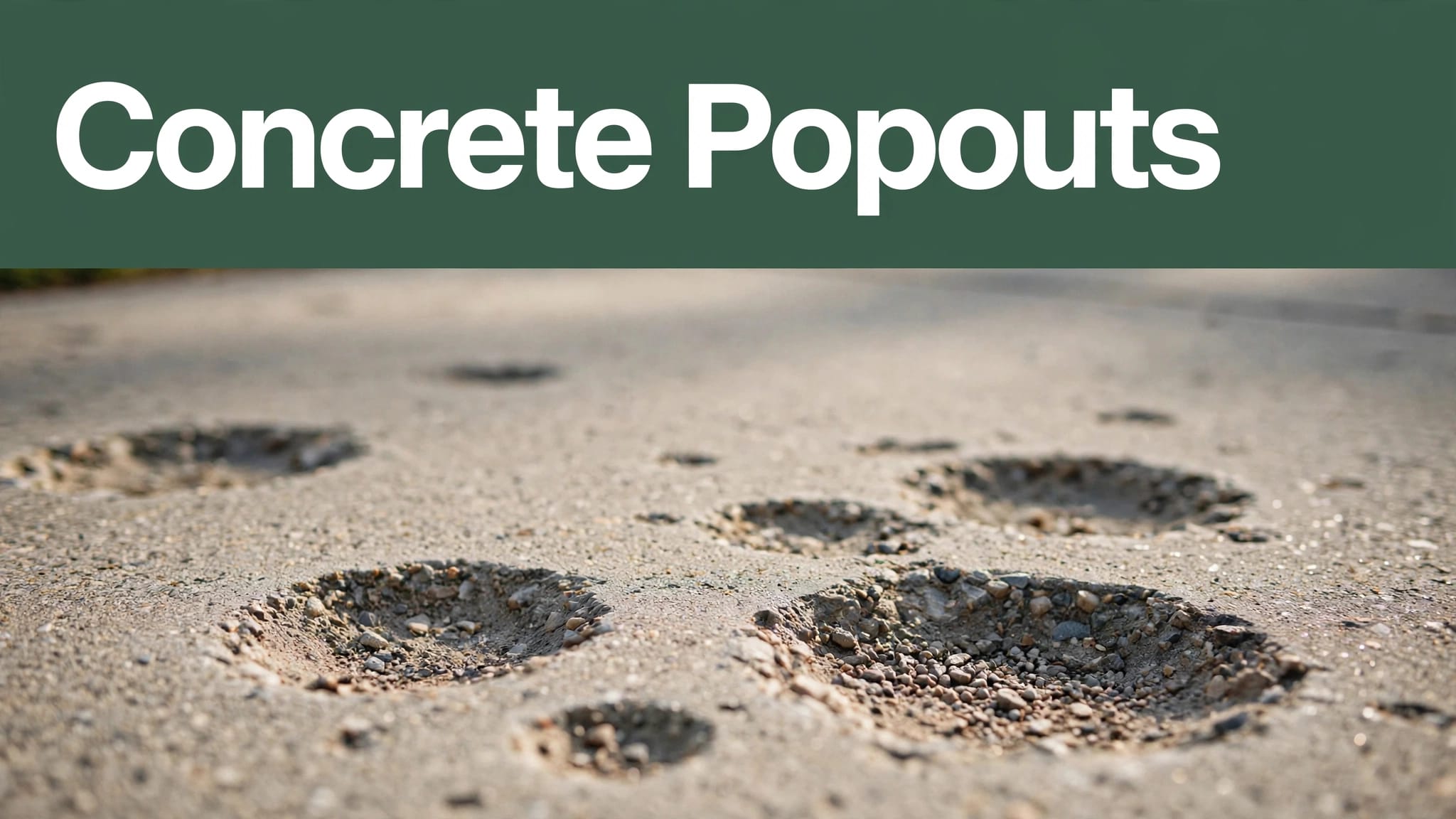
A few small holes in a driveway can look harmless, yet they may point to weak material just below the surface. Concrete popouts happen when a small piece of concrete breaks free, often leaving a shallow crater with exposed stone.
For Charleston property owners, the right response depends on the pattern, the slab’s condition, and where water travels after rain. A close look now can keep a minor surface defect from turning into a larger repair decision.
What Concrete Popouts Look Like on a Driveway
Concrete popouts are small, localized cavities. They often range from pea-sized marks to holes wide enough to expose a piece of coarse aggregate. Unlike a long crack, a popout tends to have a rounded or irregular edge around one distinct spot.

A pit forms around a single weak point
The surface mortar may break away above or around a stone near the top of the slab. What remains is a shallow hole with a rough interior, rather than a broad sheet of peeling concrete.
A driveway can have one isolated popout and remain otherwise sound. Still, photograph the area and watch whether new pits appear after heavy rain or seasonal weather changes.
Popouts differ from ordinary cracks
Cracks often follow a line through the slab. Popouts are more contained and commonly center on a piece of aggregate or another small inclusion close to the surface.
The FHWA’s aggregate distress guidance identifies popouts as a materials-related concrete surface problem. That distinction matters because filling a hole without checking the surrounding concrete can miss the reason it formed.
What Causes Concrete Popouts
A popout begins below the finished surface. Near-surface particles, contaminants, moisture, and air voids can all create pressure that breaks the thin layer of mortar above them.
Unsound or porous aggregate
Some aggregate particles absorb water or do not remain stable over time. If one sits close to the surface, it can expand and push outward until the concrete cover breaks loose.
TarmacView’s explanation of pavement popouts links the issue to near-surface aggregate or contaminants that are porous, unsound, or chemically reactive. The visible hole is small, but the source may be inside the slab.
Water and trapped voids near the surface
SpecChem notes that weak aggregate can force water and air upward, leaving voids between the surface mortar and the concrete below. A thin, unsupported layer is more likely to chip away under traffic and weather.
Charleston’s rain, persistent humidity, and coastal moisture can keep an existing weak spot damp for longer. Occasional cold snaps can also worsen damage where water has already entered pores or small openings.
A popout is usually a localized surface failure, but repeated pits across one area call for a wider look at the slab and its drainage.
Don’t Confuse Popouts With Scaling or Spalling
Several types of concrete damage can look similar at first glance. The repair plan changes when the problem is broad surface loss, a failed edge, or movement below the slab.
Scaling removes a wider surface layer
Scaling usually looks like flakes, thin chips, or patches of worn paste across a larger area. It can leave the driveway rough and expose fine aggregate, but it is not necessarily centered on individual stones.
A worn finish may show up on a concrete driveway Charleston SC homeowners use daily, especially where standing water, salt residue, or aggressive cleaning has stressed an already weak surface.
Spalling may point to deeper deterioration
Spalling is a broader term for concrete breaking away. Shallow, isolated spalling can be cosmetic. However, hollow-sounding concrete, deep loss, visible steel, movement, or recurring cracks need a professional assessment.
The same caution applies to decorative surfaces. A stamped concrete patio Charleston homeowners want to preserve may need a different finish repair than a standard broom-finished driveway. Likewise, a pool deck concrete Charleston project needs attention to surface texture and slip resistance before any coating or overlay is chosen.
Assess the Driveway Before Choosing a Repair
Start by looking beyond the hole itself. Check the grade, nearby gutters, downspout discharge, slab edges, joints, and the soil beside the driveway.
Signs a local repair may be enough
A targeted repair is often worth considering when the popouts are few, shallow, and surrounded by hard, solid concrete. The slab should sit level, with no spreading cracks or soft ground at the edges.
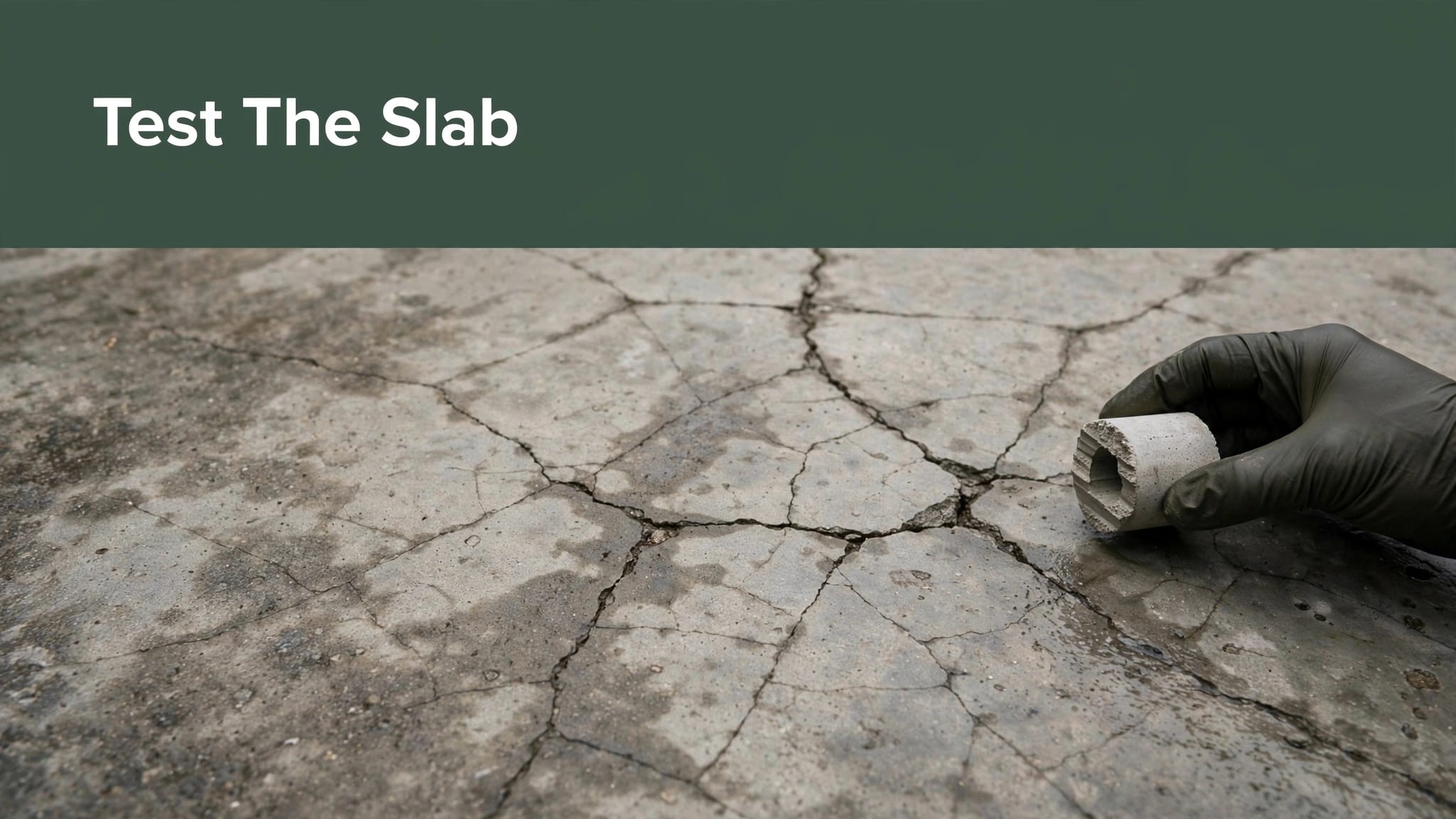
Use a screwdriver only as a light probe. If surrounding concrete crumbles easily or sounds hollow when tapped, stop treating the issue as a simple cosmetic patch.
Signs the issue may be larger
Widespread pitting, repetitive patches, low spots, ponding water, settled slabs, exposed reinforcement, and edge erosion point to more than one isolated defect. Water can also wash support from beneath a slab edge, particularly after heavy storms.
A Lowcountry concrete contractor should evaluate the surface, base, and water path together. Browse Charleston concrete advice for local guidance on runoff, driveway edges, sprinklers, and other conditions that can affect concrete.
Repair Options for Concrete Popouts
The repair has to match the damage. A patch can restore a sound slab with a few shallow defects, while extensive damage may call for resurfacing, partial-depth work, or replacement.

Localized patching for solid surrounding concrete
A contractor removes loose material until reaching firm concrete, cleans the cavity, and applies a compatible repair material. Proper surface preparation and curing matter as much as the patch mix itself.
This option fits a small number of popouts where the rest of the driveway remains stable. It will not correct settlement, a washed-out base, or a slab that keeps breaking apart around the repair.
Resurfacing for widespread shallow wear
When damage stays close to the surface but appears across a broad area, a resurfacing system may be an option after the weak concrete is removed and the substrate is prepared. It can create a more uniform appearance than many individual patches.
Resurfacing cannot restore strength to a moving or hollow slab. The driveway needs to be sound, stable, and properly drained before a new surface is installed.
Partial replacement or full replacement
A broken apron, one failed panel, or a damaged edge may sometimes be removed and replaced without tearing out the entire driveway. If the slab has broad deterioration, repeated repairs, serious movement, or lost support, full replacement may make more sense.
A quality concrete slab installation Charleston property owners can rely on starts with grading, base preparation, compaction, joint layout, and a plan for water. A new surface alone cannot solve a failing subgrade.
For an on-site assessment and repair scope, Get a Free Quote.
Prevent New Surface Damage Where You Can
No driveway is maintenance-free, but routine attention helps limit water exposure and catches damage early. The goal is to keep the slab supported and let water leave the area instead of collecting at joints or edges.
Control runoff around the slab
Keep downspouts from discharging onto the driveway. Clear gutters and drains, then watch the driveway during or after a strong storm. Water should not pool beside the garage, along an apron, or at the slab edge.
Irrigation overspray deserves the same attention. Repeated water at one joint can soften nearby soil and widen small surface defects over time.
Treat finishes according to their condition
Avoid harsh deicing products and aggressive pressure washing on worn concrete. If a driveway is clean, dry, and structurally sound, a suitable sealer may help limit water and salt entry. It will not repair an unstable slab.
This matters for every finish, including tabby concrete Charleston properties with oyster-shell character. Historic or decorative material should be identified before coating, grinding, or removing it.
Key Takeaways
- Concrete popouts are small cavities, often caused by problems around near-surface aggregate or voids.
- A few shallow pits in solid concrete may qualify for localized repair.
- Widespread pitting, hollow areas, cracking, settlement, or standing water require a fuller inspection.
- Drainage and base support matter as much as the visible surface.
- A trusted Charleston concrete services team can separate a cosmetic patch from a repair that needs deeper work.
Frequently Asked Questions
Can I patch concrete popouts myself?
A homeowner can clean and monitor a very small defect, but a durable patch requires sound concrete around the cavity, careful preparation, compatible materials, and proper curing. DIY work is a poor fit when holes multiply, concrete feels hollow, or the driveway has movement.
Will sealing stop popouts?
Sealer may reduce water and salt penetration on sound, prepared concrete. It cannot stabilize weak aggregate, rebuild lost surface material, or stop soil movement below the slab. Repair the damage and drainage issue first.
Are popouts a reason to replace the whole driveway?
Not automatically. Isolated popouts may only need patching. Replacement becomes more reasonable when damage is widespread, repairs keep failing, the slab settles, or the base and drainage problems cannot be corrected with a surface repair.
A Sound Repair Starts Below the Surface
Concrete popouts deserve attention because the visible pit may be the first sign of a weak spot. Small, isolated defects are often manageable when the surrounding slab remains solid.
The best repair matches the condition of the concrete, the support below it, and the way water moves across the property. A clear assessment prevents a quick surface fix from becoming another recurring problem.