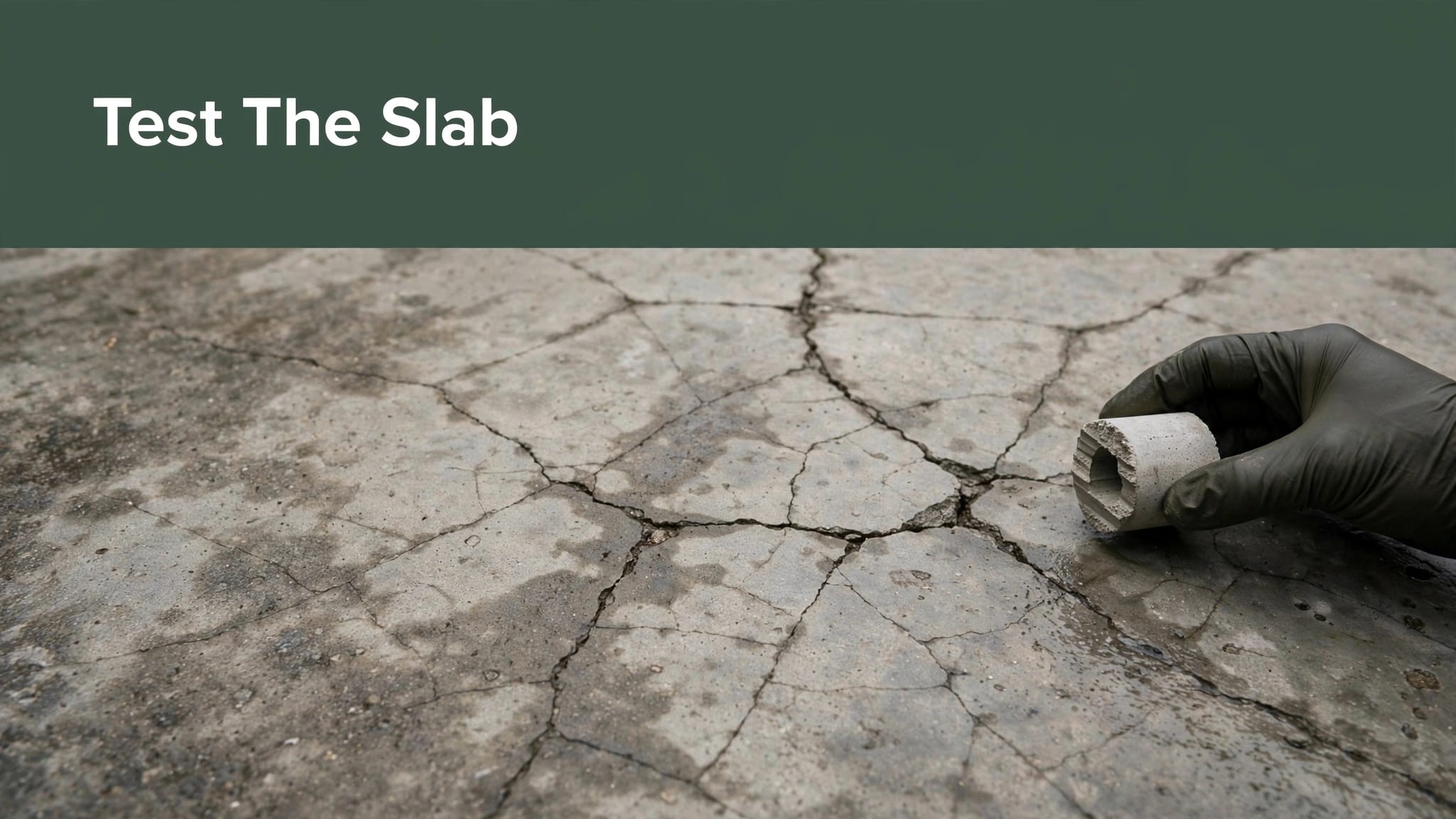
Concrete map cracking needs testing when it spreads, accompanies deterioration, or leaves the cause uncertain before a substantial repair. The branching pattern describes what you see, but it doesn’t establish crack depth, structural condition, or the right treatment.
Some networks are shallow surface crazing; others require investigation into the concrete below. For Charleston properties, the starting point is pattern plus condition, including drainage, surface wear, and movement. Separate those clues before choosing a sealer, overlay, or replacement.
Key Takeaways
- Fine, shallow crazing can affect appearance without showing that the whole slab is failing.
- Widening cracks, loose material, displacement, or distress in load-bearing concrete call for closer evaluation.
- Core examination can help investigate internal cracking, while strength testing answers a different question.
- Charleston humidity doesn’t replace proper curing, and persistent wetness deserves attention during an assessment.
What Concrete Map Cracking Looks Like
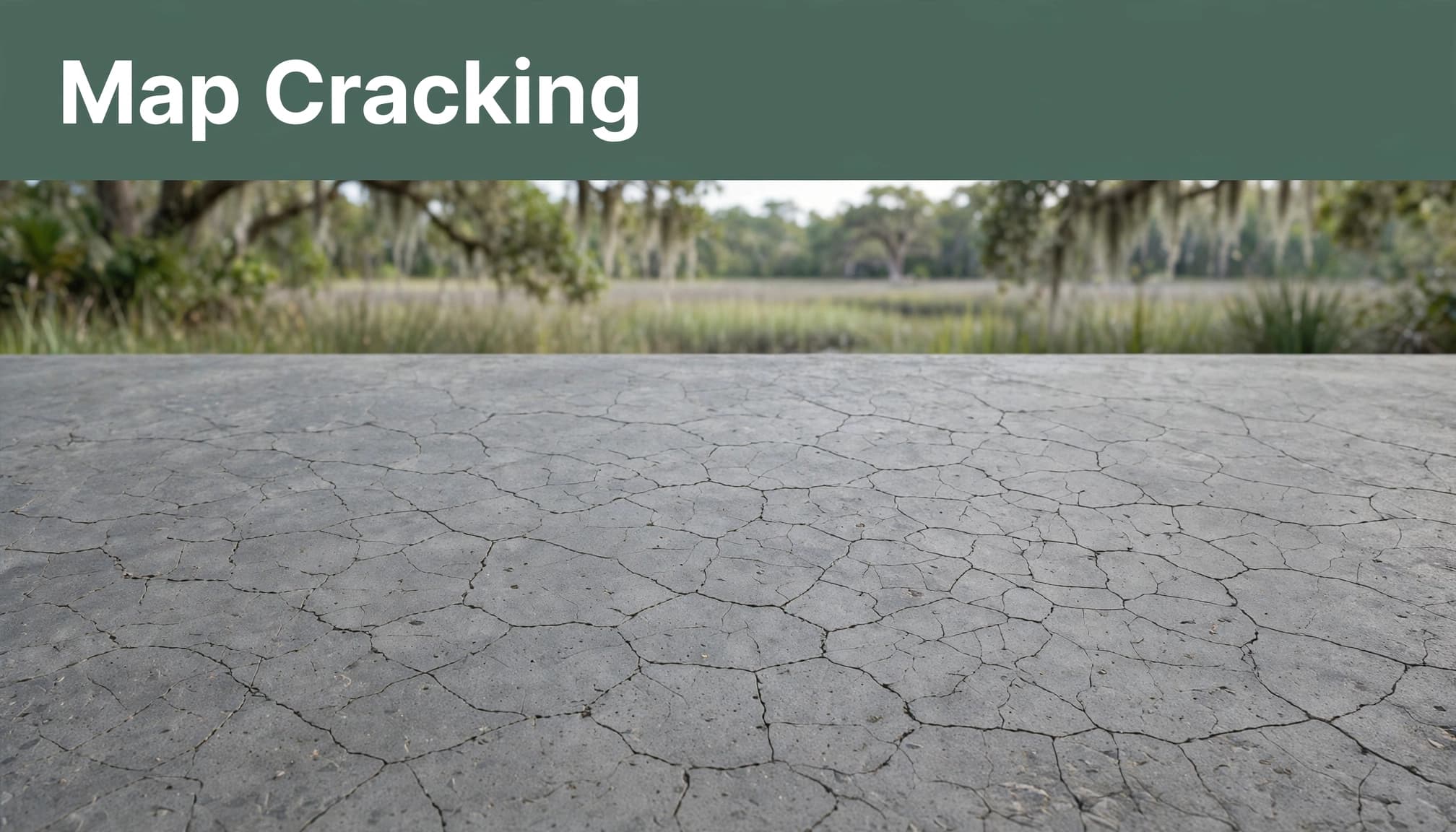
Map cracking forms an interconnected network of irregular shapes. The surface can resemble a road map, with branching lines enclosing small areas.
Fine crazing near the surface
Crazing is a fine network of shallow cracks in the cement paste near the surface. Differences in shrinkage between that layer and the concrete beneath it can produce the pattern.
It may become easier to see when concrete gets wet and then begins drying. A newly visible pattern doesn’t necessarily mean the cracks appeared that day.
Poor curing and finishing practices can contribute to crazing. However, appearance alone doesn’t establish which practice caused it, or whether the damage stops near the surface.
Cracking that deserves a deeper look
A similar-looking network can occur with internal deterioration, including alkali-silica reaction, commonly called ASR. This reaction involves susceptible aggregate, alkalis, and moisture, and can produce expansion.
The FHWA report on ASR diagnosis addresses investigation and assessment of this deterioration. A map-like pattern alone doesn’t prove ASR.
On a stamped concrete patio in Charleston, decorative texture can make cracks harder to trace. Exposed oyster shell in tabby concrete also makes careful observation important.
Why Charleston Exposure Matters
Local weather affects both fresh concrete and existing slabs. Still, coastal exposure doesn’t turn every surface pattern into the same problem.
Sun and wind can dry fresh concrete
Humid air can slow evaporation, but direct sunlight and coastal wind can still dry an exposed surface. Meanwhile, warm concrete generally gains early strength faster and gives crews less working time.
Hydration needs water. If the upper layer loses moisture too quickly, the surface can develop crazing, dusting, or reduced durability.
That’s why a curing plan must account for actual placement conditions. A shaded courtyard and an open driveway near the marsh can face different exposure on the same afternoon. Air temperature alone doesn’t describe how quickly either surface loses moisture.
Persistent moisture changes the investigation
For pool deck concrete in Charleston, splash water, irrigation, and shaded low spots can keep sections damp. Drainage patterns therefore belong in a crack assessment.
Moisture can support some deterioration mechanisms, but wet concrete doesn’t establish their presence. Similarly, a nearby downspout may explain recurring saturation without explaining every crack.
Lowcountry support conditions also vary. Soft fill, erosion, or uneven settlement can affect slab performance separately from a fine surface network. An assessment should distinguish these concerns rather than assign everything to humidity or salt air.
When Surface Patterns Need Testing
Laboratory testing should answer a decision that observation alone can’t settle. The strongest reasons involve changing conditions, unexplained deterioration, or consequences beyond appearance.
Progression and material loss raise concern
A stable, fine network on otherwise sound flatwork presents a different situation from cracks that continue opening. Changes become more concerning when loose paste, aggregate loss, or repeated patch failure accompany them.
Useful warning signs include:
- Cracks spread or become more pronounced over time.
- The surface flakes, crumbles, or loses pieces around the network.
- Adjacent sections develop a height difference or visible movement.
- Cracking appears with unusual deposits or staining that needs identification.
None of these observations identifies a cause by itself. Together, they can justify sampling before cosmetic work hides the evidence. Deposits also need interpretation because several unrelated materials can leave pale residue.
The slab’s job changes the stakes
A concrete driveway in Charleston, SC, carries vehicle loads. A patio, warehouse floor, and foundation have different performance demands.
For load-bearing concrete, distress may require a structural engineer’s assessment alongside materials testing. Significant displacement, unstable sections, or falling concrete also call for prompt professional attention.
Testing becomes more valuable before an expensive overlay or coating. If the underlying slab is deteriorating, improving its appearance won’t resolve the condition beneath the new finish.
What Concrete Testing Can Establish
A useful testing plan starts with a defined question: Is the network shallow, does cracking extend internally, or is the concrete losing integrity?

Petrographic examination investigates the material
Petrography examines concrete’s constituents and condition, often through prepared samples and microscopy. It can help investigate crack paths, paste condition, aggregate behavior, and evidence relevant to deterioration.
RJ Lee Group describes concrete petrography under ASTM C856 as part of its work investigating ASR.
Sampling locations matter because one core represents one location. A specialist may need material from distressed and less-distressed areas to understand the difference.
Core removal also needs planning around reinforcement, embedded utilities, and the slab’s function. Sampling should answer the question without creating avoidable damage. The laboratory needs the location and condition history, not just an unidentified piece of concrete.
Strength testing answers a separate question
Compressive-strength testing evaluates resistance to compression under the applicable test procedure. It doesn’t automatically explain a crack network or establish long-term durability.
A favorable strength result doesn’t establish correct slab thickness, adequate reinforcement, or stable support beneath the concrete.
Likewise, temperature records or early-age strength estimates can’t describe every condition in an existing slab. The investigation may need material examination, dimensions, drainage observations, and structural review.
The final findings should connect those results to the actual decision: monitoring, surface treatment, further evaluation, or replacement. A report that lists results without explaining their relevance leaves the repair question unresolved.
Choosing a Repair Without Hiding the Problem
Repair selection follows the condition assessment. A treatment suitable for stable surface crazing may perform poorly over active deterioration.
Stable surface distress may need limited treatment
If evaluation finds shallow, stable cracking and sound concrete beneath it, monitoring or a compatible surface treatment may be reasonable. The finish, exposure, and intended use affect that choice.
Sealers can change appearance and water absorption, but they don’t rebuild weak concrete. An overlay also needs a sound substrate and suitable preparation.
Avoid aggressive pressure washing on a questionable surface. It can remove weak paste and turn a small appearance concern into visible surface loss.
Decorative repairs deserve particular care because patches can differ in color, texture, and sheen. Even a technically suitable treatment may remain visible against the original finish.
Ongoing deterioration needs a different plan
Progressive cracking, unstable support, or internal deterioration can require more extensive work. Drainage improvements may belong in that plan, but they won’t reverse damage already present.
For a new concrete slab installation in Charleston, prevention includes suitable support, a joint plan, controlled mix handling, and curing matched to site exposure. Reinforcement doesn’t replace those measures or stop concrete from shrinking.
Our Charleston concrete services include driveways, patios, pool decks, and slabs when replacement becomes the appropriate option.
As a Lowcountry concrete contractor, we offer free quotes for residential and commercial projects. If you’re planning repair or replacement, Get a Free Quote and include photos, the slab’s use, and any known changes.
Frequently Asked Questions About Map Cracking
Does every map-cracked slab need laboratory testing?
No. Fine, stable surface crazing on otherwise sound flatwork may need observation rather than immediate sampling.
Testing becomes more useful when the cause remains uncertain, deterioration progresses, or the findings will determine a substantial repair. A concrete contractor in Charleston, SC, can assess the visible condition, while specialized laboratory or engineering work addresses questions beyond that assessment.
Can a sealer stop concrete map cracking?
A sealer may reduce water absorption or alter appearance, depending on the product and substrate. It won’t establish the cause, restore lost material, or stop movement beneath the slab.
Applying one before an assessment can also complicate surface preparation for later work. Where diagnosis matters, preserve the visible evidence until the evaluation is complete.
Is map cracking always caused by poor workmanship?
No. Finishing and curing problems can contribute to shallow crazing, but similar patterns can accompany material deterioration.
The slab’s age, exposure, crack distribution, and other symptoms help guide the investigation. Our Charleston concrete advice covers related planning and maintenance concerns, including how weather and surface care affect local concrete.
Match the Response to the Condition
Concrete map cracking deserves a response based on depth, progression, and performance. A fine network may remain a surface issue, while changing cracks and material loss justify closer investigation.
Before covering the pattern, establish what the proposed repair needs to accomplish. Testing is most useful when its findings change that decision and help avoid treating a deeper problem as a cosmetic one.

