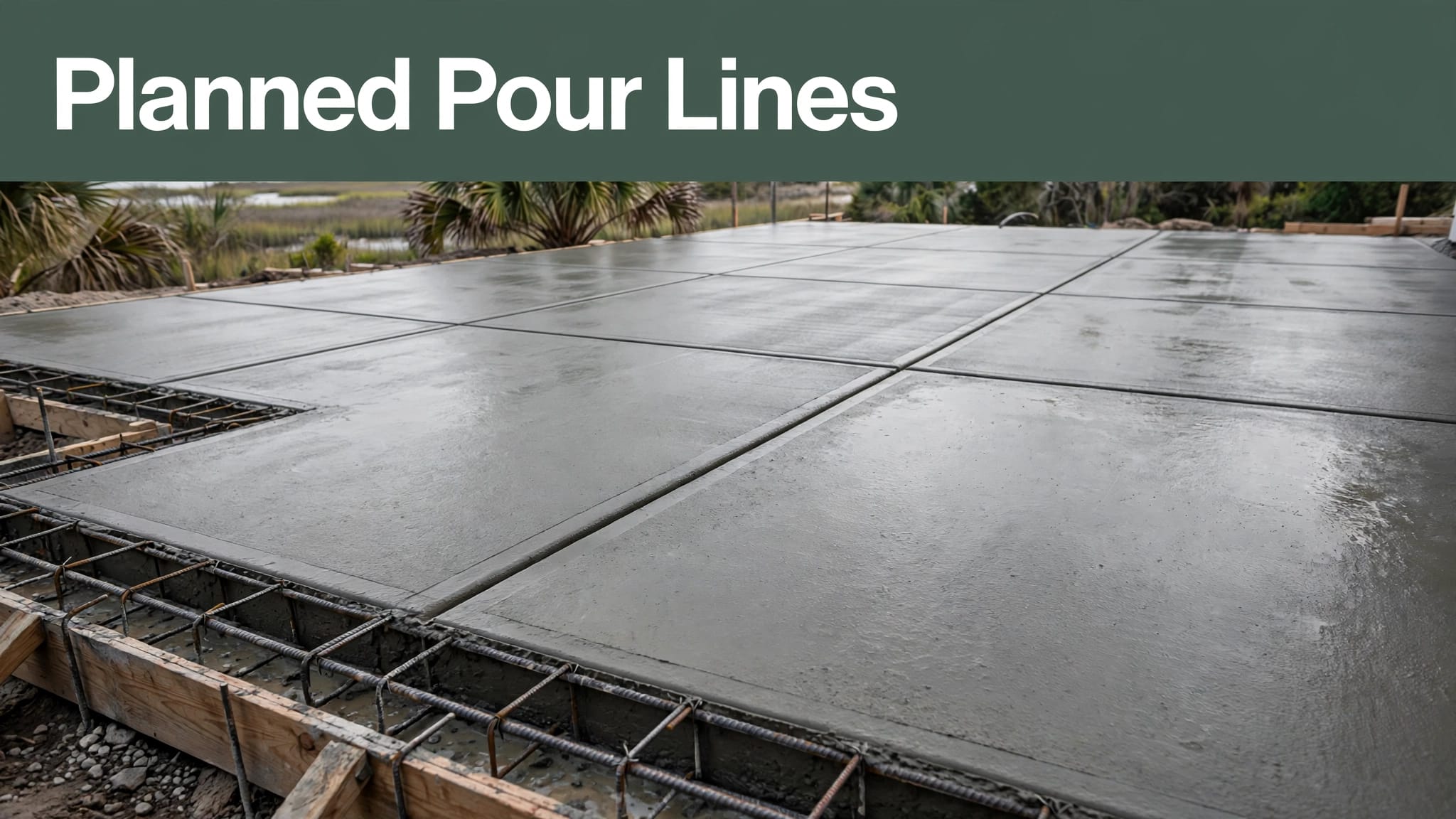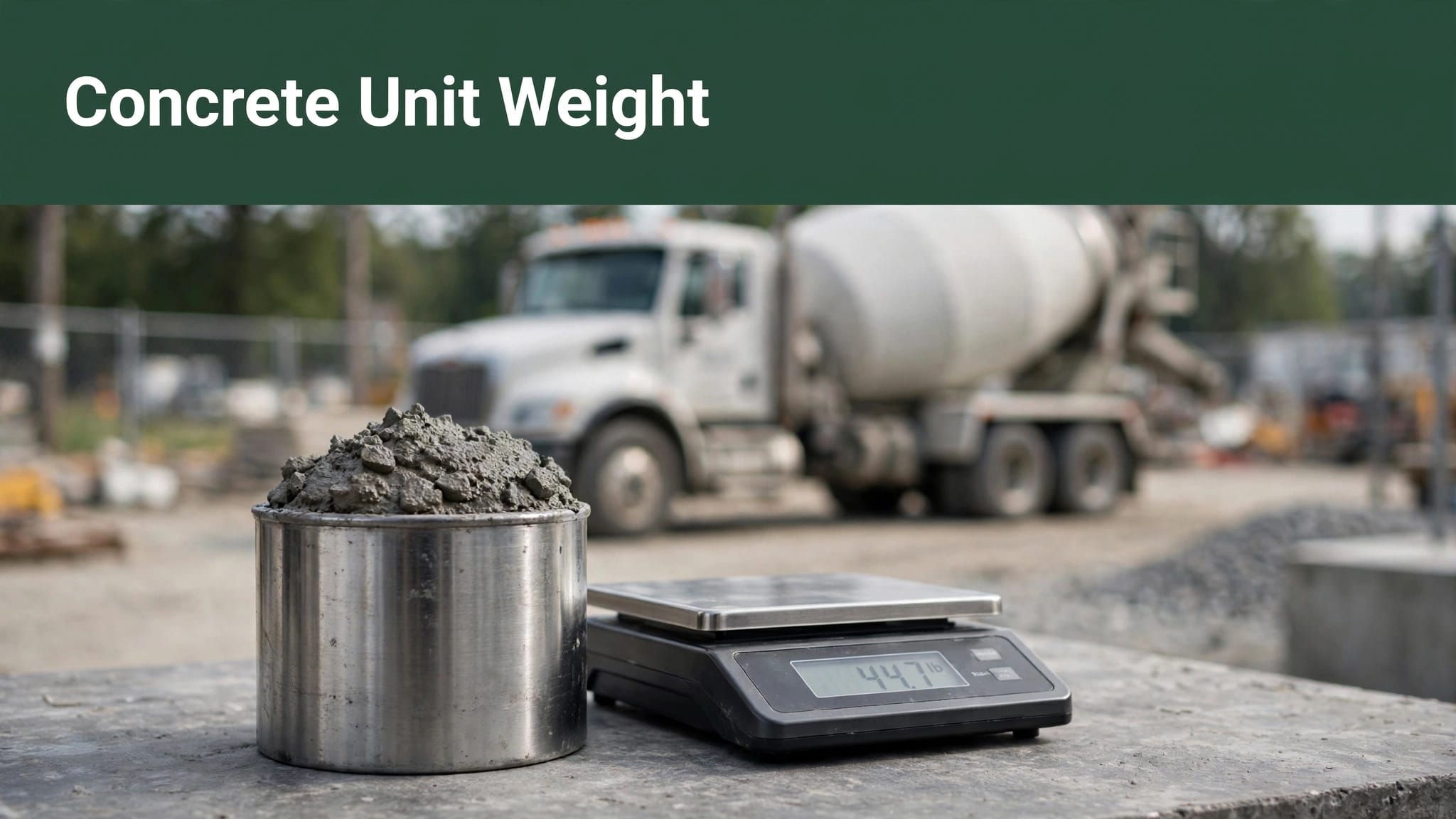
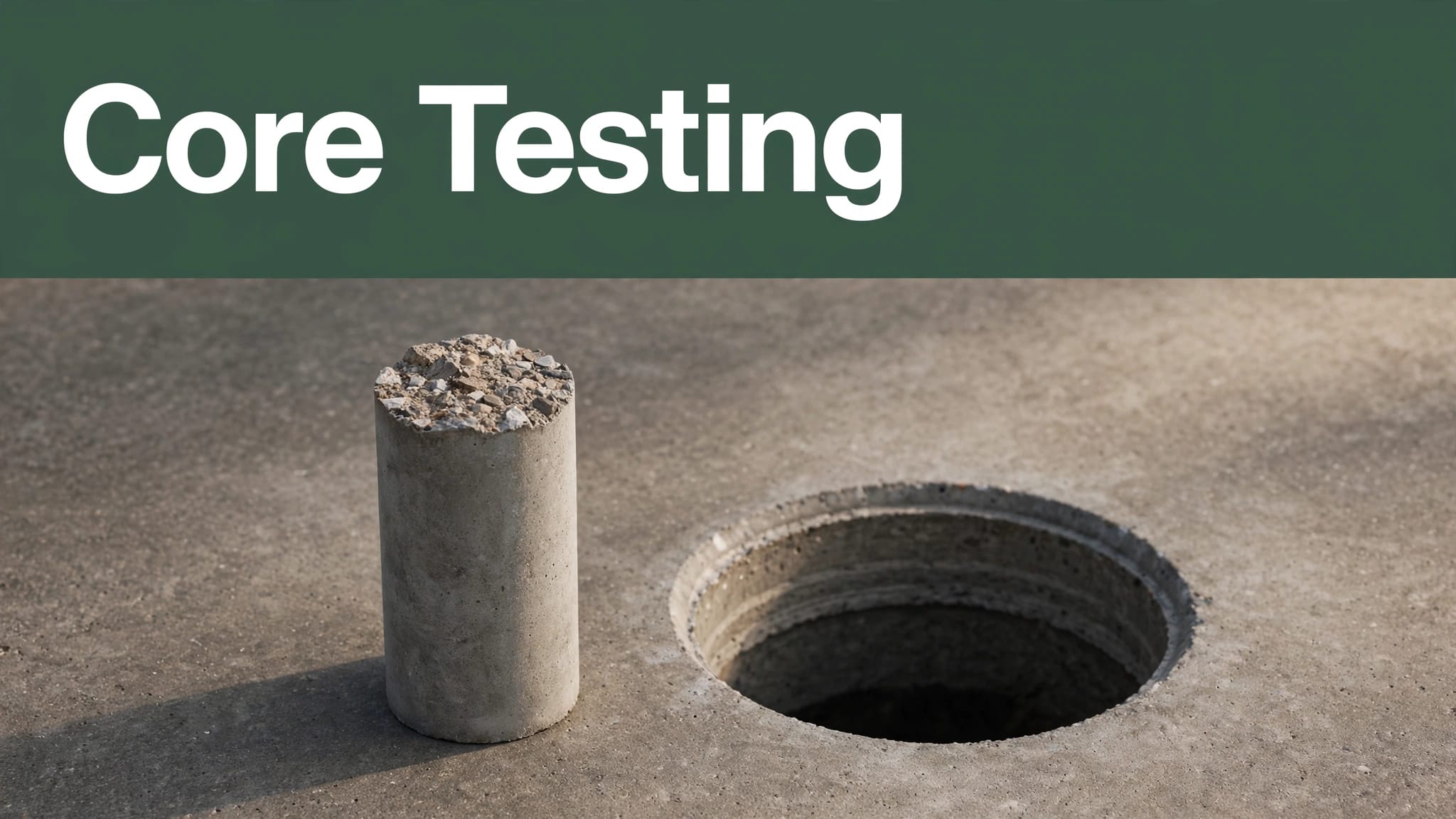
A slab can look solid while hiding a thin section, a weak layer, or a separation beneath the finish. When those possibilities affect a repair or construction decision, concrete core testing provides a core sample that shows what’s inside.
For Charleston homeowners and businesses, core sampling can help settle questions about a concrete slab that photos and surface checks can’t answer. The useful result starts with choosing the right location and ends with reading the lab report in context.
What concrete core testing can reveal
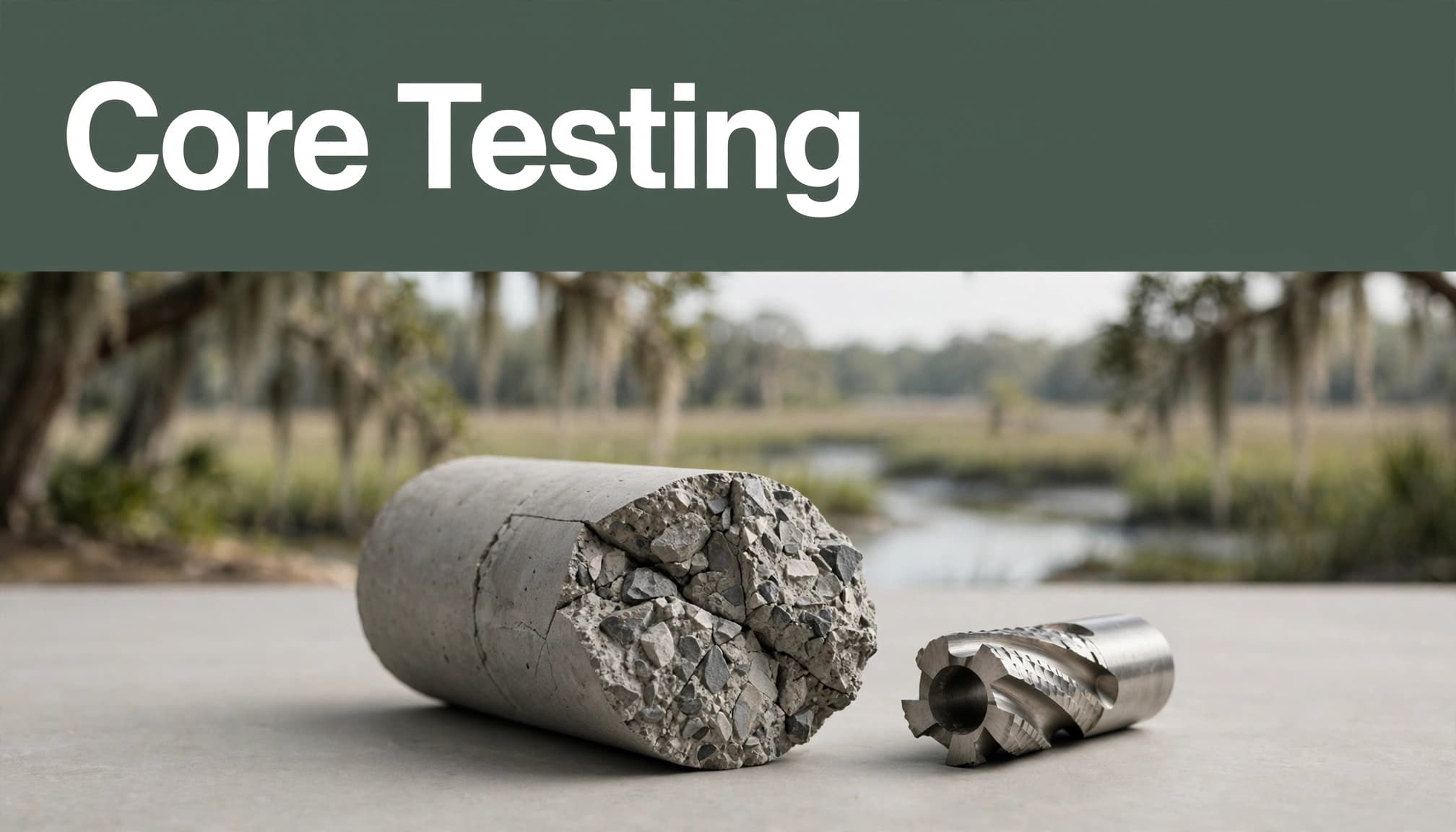
A concrete core sample is a cylindrical piece drilled from an existing slab with a diamond-tipped bit. Its exposed sides show slab thickness and cross-section. Depending on the investigation, a laboratory may also test the sample’s compressive strength.
Thickness, layers, and visible defects
Core sampling can confirm whether a topping sits over an older slab or whether the concrete is thinner than plans suggest. It may reveal voids, poor consolidation, cracking, delamination, aggregate distribution, or a weak-looking interface between layers.
Those observations need context. A visible separation raises a bond question, but a core alone doesn’t measure bond strength across an entire floor. Likewise, one core sample describes one location, not every square foot of concrete.
Measured strength and further analysis
A testing laboratory can load a prepared core until it fails and report its strength in pounds per square inch (psi). ASTM C42/C42M governs obtaining and testing drilled cores, including strength-testing procedures and length measurements. Other requested tests must follow their applicable methods.
A separate splitting tensile strength test may be appropriate for some investigations. Flexural strength isn’t inferred from a core’s result and generally requires a suitable beam specimen.
If the concern involves deterioration rather than strength alone, an engineer may request separate petrographic or chemical analysis. Microscopic examination can help investigate internal cracks and material condition. Testing for chlorides or sulfates may be useful when exposure or contamination is suspected.
When an existing slab needs a core
Core sampling removes concrete and leaves a hole that needs repair. Use it when an unresolved question could change a repair or construction decision, and the surface can’t provide the answer.
Flooring failures and hidden layers
In a commercial space, a flooring failure may involve peeling coating or tile that loses bond. It can raise questions about an old topping, contaminated concrete, or delamination.
Core sampling can reveal the layer sequence, while a core sample provides material for further examination.
Moisture is a separate part of that investigation. Wet core drilling adds water, so moisture observed in a newly drilled hole doesn’t establish the slab’s original condition. A flooring professional should choose appropriate moisture testing for the proposed floor system.
Strength and structural concerns
Core sampling may be appropriate when records are missing, earlier strength results raised concerns, or a planned change will add loads. An engineer may also call for cores near significant cracking or suspected weak concrete.
Before core sampling, clarify the decision: Is the team verifying thickness, investigating a flooring failure, or evaluating strength? That answer determines locations, sample count, and laboratory work. For structural concerns, a licensed structural engineer should direct the investigation.
Cores and non-destructive tests work together
Several checks can narrow an investigation before anyone cuts into the slab. Non-destructive testing methods don’t all answer the same question.
A rebound hammer, sometimes called a Schmidt hammer, responds to surface hardness. It can help identify areas that differ, but its reading isn’t a direct compressive-strength test. Ground penetrating radar (GPR) can help map embedded features and changes within concrete. Impact-echo testing can help investigate thickness or internal discontinuities when conditions suit the method.
A core sample provides a physical specimen from a chosen spot. Non-destructive testing can help select that spot and assess a wider area. An engineer may use both core sampling and screening rather than treating either as a complete picture.
A strong core from one location doesn’t explain a failing floor across the room. The sample must represent the condition being investigated.
For example, a flooring failure with several hollow-sounding areas may call for a survey before a core location is selected. Testing only the easiest spot to reach could miss the damaged zone.
How a crew extracts and protects a core
Good laboratory work can’t correct a poorly chosen hole or damaged core sample. The field plan matters as much as the compression machine.

Check what’s below the drill
Before core sampling, the team reviews available plans and information about utilities, reinforcement, embedded systems, and slab thickness. Ground penetrating radar (GPR) helps identify potential conflicts such as rebar, conduit, and post-tensioning tendons. Scanning reduces risk, but it can’t guarantee that every buried item has been found.
The engineer should approve core sampling locations on a structural slab. A hole near an edge, column, or concentrated load may have different consequences than one in open flatwork. The crew also needs access to the underside when a full-depth cut could affect a finished space below.
Drill without creating another problem
A water-cooled diamond bit uses core drilling to cut the cylinder while limiting heat and airborne dust. During core drilling indoors, the crew should contain and collect slurry before it reaches flooring, drains, or adjacent rooms. Outdoors, they should protect nearby surfaces and manage the drilling water.
After core extraction, the technician records the location, orientation, and visible condition of each core. Cracks or broken sections should be documented, not silently trimmed away. The ASCC concrete core testing checklist highlights why sampling details need attention before results are compared.
Label, transport, and repair
Each core sample needs a clear identifier tied to its location. Handling also matters: ASTM C42/C42M calls for surface water to be wiped off after drilling and for cores to be sealed after the surface appears dry, no later than one hour. Unless the test specifier directs otherwise, its standard procedure keeps them sealed for at least five days after their last wetting.
After core sampling is complete, the hole needs a repair suited to the slab’s use and exposure. A patch in a structural floor calls for a different detail than one in ordinary exterior flatwork. The engineer or project specification should determine the repair where capacity, reinforcement, or waterproofing matters.
How the laboratory reads a core
The lab prepares and measures a core sample before loading it. Reported psi is useful, but dimensions, moisture conditioning, and visible defects affect interpretation. If the material condition warrants further investigation, microscopic examination may provide additional insight.
Moisture condition and compressive strength
Moisture amount and distribution can affect measured results. The report should state how the specimen was handled and conditioned. No standard procedure guarantees a drilled core has the same moisture condition it had inside the slab.
This matters when samples come from different environments. Don’t compare an exterior specimen exposed to rain with an interior one without reviewing the test method and conditioning records.
Length-to-diameter ratio
A short core may show a different apparent result than a taller specimen of the same diameter. ASTM C42/C42M identifies a length-to-diameter ratio of 1.9 to 2.1 as preferred after end preparation. At a ratio of 1.75 or less, the method requires a correction factor.
For example, the listed factor is 0.96 at a ratio of 1.50 and 0.87 at 1.00. A qualified lab applies the required correction and reports the dimensions. Don’t compare an uncorrected result with a specification or base a repair decision on it alone.
What an ACI 318 strength result means
A core result needs the project’s specified strength and an engineer’s judgment. The familiar ACI 318 threshold has a defined use; it isn’t a universal pass-or-fail rule for every older driveway or patio.
The three-core criterion
For concrete evaluated under the applicable ACI 318 pathway, the area represented by three cores is considered structurally adequate when their average strength reaches at least 85% of the specified strength and no individual core falls below 75%.
If the specified compressive strength is 4,000 psi, those thresholds are a 3,400 psi average and a 3,000 psi minimum for each core. An ACI educational example of core evaluation lays out that distinction. The criterion belongs to the code-based evaluation, not to ASTM C42 itself.
Why one number cannot settle the slab
As part of a structural assessment, the engineer must decide what area each core sample represents and whether the criteria apply. An older slab may have no reliable record of specified strength. Even adequate compressive strength can’t establish sound subgrade support, good drainage, or intact reinforcement.
Research on evaluating in-place concrete strength also shows why drilled-core results require careful interpretation. Core sampling location and specimen condition belong in the discussion alongside psi.
Applying results to Charleston repairs and upgrades
Lowcountry slabs face heavy rain, persistent humidity, and, in some locations, salt exposure. Core sampling can identify material concerns. Repairs must also address water or support issues when those are contributing factors.
Match the question to the surface
A concrete driveway in Charleston, SC with settlement may need its base and drainage assessed before anyone orders strength tests. On a pool deck, a flooring failure, hollow areas, or a failing finish may make layer condition more relevant. For a stamped concrete patio, a core sample leaves a visible repair, so the location deserves extra care.
Decorative tabby concrete with oyster shells poses a similar finish-matching concern. The sample may be valuable, but the testing plan should account for the appearance of the repaired spot.
Decide whether to repair or replace
A core showing sound concrete beneath a shallow defect may support a limited repair. Widespread weak material, deep separation, or movement can point toward a larger scope. The result doesn’t choose a patch product or establish the condition of the entire slab.
When replacement is warranted, concrete slab and foundation installation should start with the intended loads, base preparation, drainage, and project specifications. That applies whether a Lowcountry concrete contractor is replacing a garage slab or planning commercial flatwork.
Turn the findings into a usable plan
Ask for a core sampling report that ties each core sample to a marked location. It should identify slab thickness, visible layers or defects, core dimensions, conditioning, test method, and results. Photos help connect the lab findings to what the crew saw on site.
Then separate measured findings from professional decisions. The lab reports what it measured in the in-place concrete, but it doesn’t make a structural assessment. A structural engineer interprets load-bearing concerns. A flooring specialist may recommend moisture testing if a flooring failure occurred or a finish is planned. The concrete contractor can then price the defined repair, rather than guessing from a surface stain or crack.
If an assessment points toward repair or replacement, Get a Free Quote for the concrete work. For related local topics, see these concrete testing and project guides.
Key Takeaways
- A core reveals actual thickness and layers at its location and can provide a specimen for laboratory strength testing.
- GPR and other non-destructive checks help select locations, but they do not replace a physical sample when direct testing is needed.
- Core dimensions, moisture conditioning, and handling affect how a compressive-strength result is interpreted.
- Structural acceptance and repair decisions belong with the applicable plans, criteria, and qualified professionals.
Frequently Asked Questions
Will drilling a core weaken my slab?
Coring removes material, so location and repair matter. A qualified team plans the hole around reinforcement and embedded systems, then repairs it to suit the slab. An engineer should direct sampling when structural capacity may be affected.
Can one core prove my entire slab is strong enough?
No. One sample describes its location. The number and placement of cores should reflect the question and the area being evaluated. A structural decision may also require drawings, a site inspection, and other tests.
Does a core test diagnose a flooring moisture problem?
A core can reveal layers and supply material for further analysis. Wet drilling changes local moisture conditions, however, so the fresh hole alone cannot establish whether a floor is dry enough for a new covering. Use a moisture test selected for that purpose.
Is core testing needed for every residential slab?
Most routine patios and driveways don’t need cores simply because they have a small surface blemish. Testing becomes more useful when the outcome could change a substantial repair, resolve a disputed material question, or inform work on a load-bearing slab.
Conclusion
A smooth slab can hide a problem, but an isolated psi result can also tell too little. The strongest diagnosis connects the sample to a clear question, careful drilling, and the conditions observed across the slab.
When those pieces line up, owners can choose a repair based on evidence rather than appearance alone.