
Shallow flaking may be cosmetic, but hollow areas, exposed reinforcement, cracking, or movement can signal deeper deterioration beneath the surface. Charleston’s coastal humidity, heavy rain, salt exposure, water intrusion, standing water, and poor drainage can weaken vulnerable concrete, while occasional cold snaps may worsen existing damage.
An inspection can determine whether the slab still has adequate strength and guide the right fix: surface patching, concrete resurfacing, or replacement. The choice depends on the damage’s depth and movement, so potentially structural damage shouldn’t be handled as a DIY project.
Key Takeaways
- Concrete spalling may be cosmetic when shallow and isolated, but hollow areas, exposed reinforcing steel, deep cracks, settlement, or slab movement can indicate deeper deterioration.
- Charleston’s humidity, salt exposure, water intrusion, poor drainage, weak surface preparation, and occasional freeze-thaw cycles can contribute to spalling.
- Choose between patching, resurfacing, partial-depth repair, or replacement based on the damage’s depth, extent, movement, substrate condition, and underlying cause.
- Long-lasting repairs require removal of all unsound concrete, clean and properly prepared surfaces, compatible materials, accurate mixing, and complete curing.
- Correct drainage, maintain joints, inspect repairs after heavy rain, and consult a qualified contractor or structural engineer when structural damage or corrosion may be present.
How to Tell If Concrete Spalling Is Serious
Concrete spalling is the loss of a concrete surface layer. It may look like peeling, shallow craters, exposed aggregate, or small chunks breaking away along an edge or joint.
Isolated, shallow loss over solid concrete may be cosmetic. Widespread pitting, hollow areas, exposed steel, slab movement, or cracks through the slab can threaten its structural integrity.
The visible surface damage matters, but what sits below it matters more. A neat-looking patch won’t hold if weak concrete remains around its edges.
Look beyond the loose flakes
Start by checking the size, location, and pattern of the damage. One small pit near a downspout may point to drainage. Repeated flaking across an entire driveway often points to a weak original surface, moisture exposure, or a finishing problem.
Watch for these warning signs:
- Pitting that has spread beyond a few isolated areas.
- Cracks that run through the spalled section or along slab joints.
- Rust-colored staining, longitudinal cracks, or exposed reinforcement, which may indicate corrosion of embedded metals.
- A hollow sound when you tap nearby concrete with a hammer handle.
- Uneven slabs, soft soil at the edges, or water that sits after rain.
A qualified concrete repair contractor should evaluate hollow or deteriorated areas before patching. Consult a structural engineer if damage reaches reinforcing steel or involves slab movement. Get an engineering evaluation for damage affecting a beam, elevated element, or load-bearing capacity.
Test for hidden separation
Sound concrete gives a sharp ring when tapped. Concrete separated below the surface often makes a dull, hollow sound. Contractors may use a hammer, steel rod, or chain drag to map likely delamination before removal. These checks aren’t a substitute for professional assessment.
Mark the hollow spots with chalk, then set a repair boundary in solid material. The visible edge isn’t reliable because weak concrete can extend beyond the flaking.
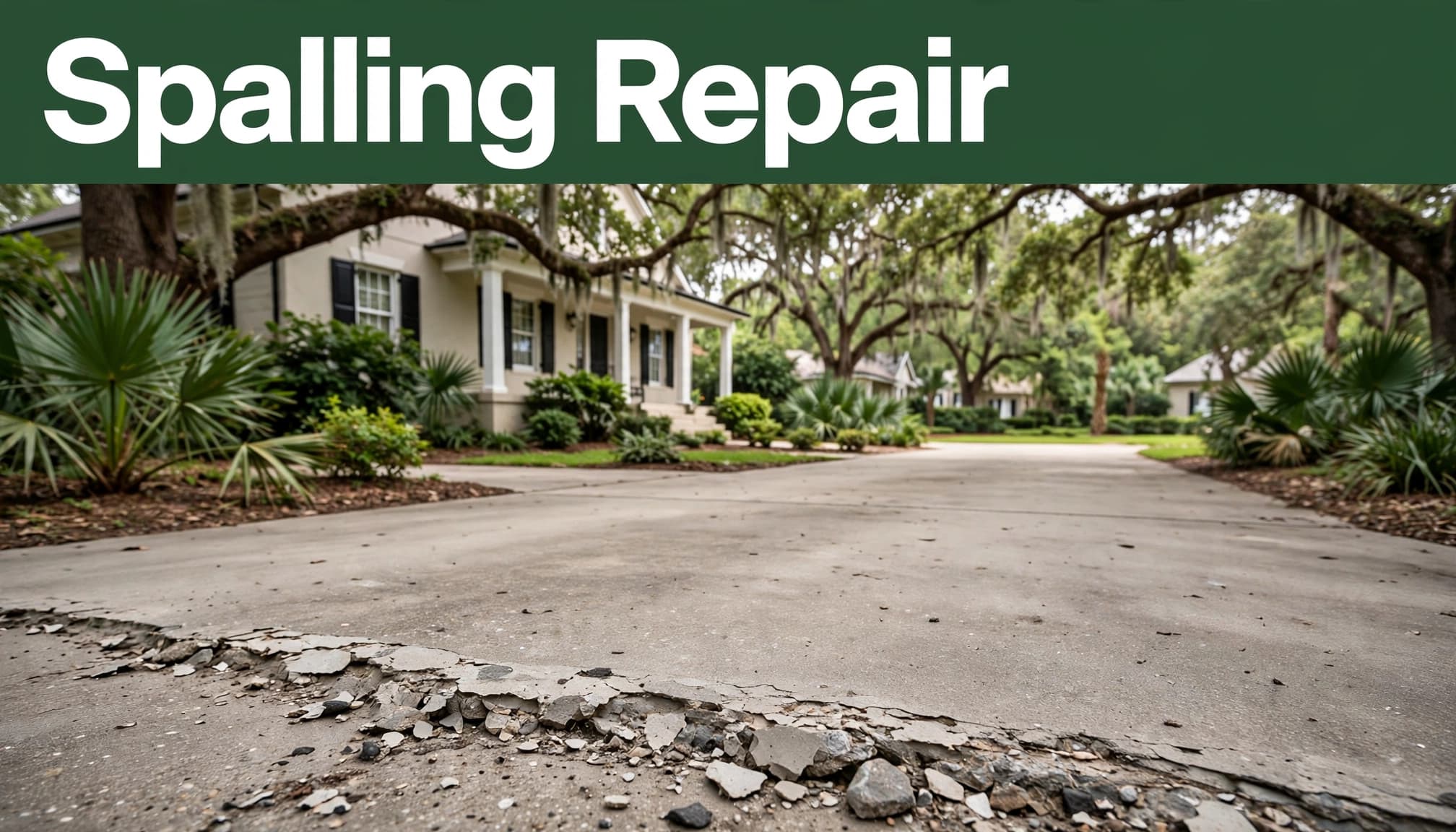
A repair should extend past the visible spall into sound concrete, or the new edge can break loose within a season.
Why Charleston Concrete Begins to Spall
Charleston’s coastal humidity, salt-laden air, windblown salt, and rain-saturated concrete can contribute to concrete spalling. Pooled water and poor drainage keep surfaces wet, while occasional freeze-thaw cycles in Charleston can damage water-saturated concrete with poor air entrainment. Charleston’s risk is lower than in northern climates, but cold snaps matter when water remains trapped in the slab. The FHWA’s overview of freeze-thaw distress explains how susceptible concrete and aggregate can deteriorate when water freezes and thaws.
Water, salt, and a weak surface layer
Concrete is durable, but it isn’t waterproof. Water enters through pores, hairline cracks, unsealed joints, and poorly sloped areas. Pooled water and poor drainage keep concrete saturated, allowing moisture to worsen surface scaling and internal deterioration.
De-icing salts are a familiar cause in colder regions, but they’re rarely used locally. Saltwater splash, windblown chlorides, and humid conditions can carry salts deeper into cracks and pores. Recent research on salt and deicer exposure describes how salts can contribute to scaling, cracking, and other forms of concrete damage.
Poor installation can set the stage years earlier. Adding too much water to a concrete mix raises its water-cement ratio and leaves a more porous surface. Improper finishing while bleed water remains at the surface can weaken the surface paste and promote scaling.
Reinforcing steel can push concrete apart
When chlorides and moisture reach reinforcing steel, corrosion of embedded metals creates expanding rust. That pressure pushes outward on surrounding concrete, causing cracking, delamination, and spalling.
This type of damage often shows rust stains, long cracks following the line of rebar, or exposed steel. An overview of chloride-driven concrete deterioration details the connection between chloride ingress, steel corrosion, cracking, and spalling.
A patch over active corrosion only conceals the problem and doesn’t stop the pressure. Deeper removal and corrosion treatment require a qualified contractor, and the repair system must match the exposure. An engineer should be involved when structural capacity may be affected.
Concrete Spalling Repair: Patch, Overlay, or Replace?
The right repair depends on depth, extent, and what caused the failure. A small cosmetic patch and a slab with structural distress don’t belong in the same repair plan.
| Damage condition | Practical repair approach | When it fits |
|---|---|---|
| Isolated shallow pits | Surface patching with repair mortar | Only when surrounding concrete is sound and the base is stable |
| Broad shallow scaling | Concrete resurfacing with a bonded concrete overlay system | Damage is widespread but surface-deep, with a sound substrate |
| Deep spalls around steel | Partial-depth structural repair | Sound concrete remains below the damaged zone; corrosion of embedded metals may be active |
| Cracking, settlement, deep deterioration | Full-depth repair or replacement of deteriorated concrete | The slab or base has lost reliable support |
Choose compatible repair materials for the conditions, not just the product label. Don’t select a patching compound solely by its label or price. Bond strength, permeability, traffic, moisture, and exposure all matter.
Cementitious mortars work well for many residential walks and patios. Epoxy repair mortar can suit heavy-duty commercial floors where equipment traffic demands high bond strength and abrasion resistance.
Active corrosion changes cosmetic patching into a deeper repair requiring steel exposure, cleaning, protection, and professional evaluation.
When a patch is the sensible choice
A localized patch is appropriate when damage is confined to the slab’s upper portion, surrounding concrete sounds solid, and the base hasn’t settled. Remove every weak edge first.
Even the right product can fail if unsound concrete or contamination remains. Surface preparation should leave the exposed area clean and rough before patching.
Federal pavement guidance uses the top one-third of slab thickness as a practical screening limit for partial-depth repair, not a guarantee. It’s useful for property owners, but damage approaching or exceeding that depth needs a qualified concrete repair contractor’s review. Extensive corrosion, cracks through the slab, settlement, or loss of load support also warrant review. If structural deterioration is possible, involve a structural engineer. DIY patching isn’t appropriate for structural damage.
When replacement is the better investment
Replacement makes more sense when spalling covers large areas, runs through the slab, exposes extensive corroded steel, or pairs with movement and drainage failure. Repeated patching over a weak slab becomes expensive and unattractive.
For a new concrete driveway and patio installation, proper base preparation, slope, joint layout, mix selection, and curing prevent many of the issues that make later repairs necessary.
Surface Preparation Decides Whether a Repair Bonds
New patches can’t compensate for dusty, loose, smooth, or contaminated concrete. Most early patch failures trace back to skipped preparation steps.
Remove unsound concrete first
Mark the repair area beyond every hollow section. Sawcut a clean perimeter where needed, then chip or mechanically remove loose concrete until only firm material remains.
Don’t feather the repair edge to nothing. A squared boundary gives new material enough thickness to resist traffic and weather. Clean out dirt, oil, algae, old coatings, and dust before bonding.
For suitable exterior surfaces, a pressure washer may help remove residue. Excessive pressure can drive water into cracks or leave the concrete too wet for bonding. Follow the repair products’ requirements for a saturated-surface-dry substrate, primer, bonding agents, and curing.
Create the right moisture condition
A cementitious repair mortar often needs a saturated-surface-dry substrate. The concrete should be damp internally but free of puddles when the material goes down. Dry concrete can pull water from fresh material too quickly and weaken the bond.
Follow the manufacturer’s mixing ratio exactly. Extra water makes placement easier briefly, but it reduces strength and increases shrinkage risk. After placement, compact the material, finish it to match the surrounding surface, and cure it for the full recommended period.

Shallow, nonstructural repairs may suit an experienced homeowner. Have a qualified concrete repair contractor handle deeper removal, exposed reinforcing steel, load-bearing slabs, elevated concrete, or widespread deterioration. In Charleston, SC, the contractor should inspect the slab before demolition begins.
If corrosion of embedded metals is present, the work may require exposing enough steel to clean it properly, applying a compatible corrosion-protection system, and restoring adequate concrete cover. Ask an engineer to review the repair if the steel appears significantly reduced, the slab moves, or structural capacity is uncertain.
Match the Repair to the Concrete Feature
Traffic, drainage, finish type, salt exposure, and nearby water all affect the repair choice. A driveway patch shouldn’t receive the same treatment as a decorative patio or pool surround.
Driveways and high-traffic walks
A concrete driveway in Charleston, SC, faces vehicle weight, runoff, coastal moisture, and occasional chemical exposure. These conditions can make shallow damage progress faster than damage on a lightly used patio.
For isolated shallow damage, dense polymer-modified repair mortar can restore the surface. High-traffic repairs depend on surface preparation, including sound edges, proper cleaning, correct depth, and adequate curing. Larger areas of shallow scaling may need a bonded overlay.
Keep repairs out of active control joints whenever possible. If a joint has failed, restore it after the patch cures so the slab can still move as intended.
Commercial sidewalks and loading areas need a tougher evaluation when heavy traffic, forklift routes, dumpsters, and frequent point loads are involved. These conditions can turn a small spall into a trip hazard or broken slab edge. Owners should coordinate cure time and access restrictions before setting a return-to-service date.
Patios, pool decks, and tabby surfaces
A stamped concrete patio in Charleston needs more than a gray patch. Repair materials, texture tools, color hardener, and sealer must work together, or the repair will stand out.
Replacement may be cleaner when an entire stamped panel contains deteriorated concrete. It can also make sense for widespread pool-deck loss or tabby shell aggregate that can’t be matched convincingly.
Pool deck concrete in Charleston needs a slip-resistant finish and drainage away from the waterline. Salt splash near pools and coastal properties can also affect the repair. A smooth, dense overlay may become slick when wet, so texture belongs in the repair plan.
Traditional tabby concrete in Charleston has its own character because oyster shell is part of the visible finish. Match repairs carefully, and test a small area before treating a highly visible surface.
For replacement decisions, ask a Lowcountry concrete contractor about soil conditions, runoff paths, and the slab’s intended use. Check whether water flows toward slab edges, and have a qualified contractor or engineer assess deep cracking, settlement, exposed steel, or widespread loss. Good concrete slab installation in Charleston starts below the finished surface.
Stop New Surface Damage Before It Starts
A repair lasts longer when water has a way to leave. Clean gutters, redirect downspouts, maintain joint sealant, correct the grade where runoff repeatedly crosses concrete, and eliminate standing water. These preventative measures limit repeated wetting around repaired areas.
Seal after curing, not before
Breathable penetrating sealers are protective sealants that can reduce water absorption without trapping moisture inside the slab. They can’t repair delamination, stop active reinforcement corrosion, correct settlement, or restore structural capacity. Sealing is preventive, not curative, and can’t reverse corrosion of embedded metals.
To cure and seal correctly, wait until fresh repair mortar or an overlay completes the manufacturer’s required cure. Then choose a product rated for the surface and local exposure. Coastal humidity and salt exposure make product compatibility and maintenance especially important.
Film-forming coatings can work in some settings, but they need sound, dry concrete and regular maintenance. If moisture pressure builds below a failed coating, peeling can look like a new repair failure.
Keep an eye on repaired areas
Inspect repaired sections after heavy rain and during seasonal weather changes. New hollow sounds, hairline cracks, rust-colored staining, or spreading discoloration may signal recurring deterioration, including concrete spalling, beneath the repair. Don’t assume the sealer failed, since these signs can also reflect movement, moisture, or damage below the surface.
Property owners planning a broader upgrade can find practical Charleston concrete advice on outdoor slabs, finishes, and weather-related concrete decisions.
Frequently Asked Questions
Can shallow concrete spalling be repaired with a patch?
A localized patch may work when the damage is shallow, the surrounding concrete sounds solid, and the slab and base remain stable. Remove all weak concrete and contamination first so the repair can bond to a firm, properly prepared surface.
When does concrete spalling require replacement?
Replacement may be the better option when spalling is widespread, extends through the slab, exposes extensively corroded steel, or occurs with settlement, movement, or drainage failure. Repeated patching over a weak slab can become more expensive and less reliable than replacement.
Is concrete spalling caused by water or salt exposure?
Water enters through pores, cracks, joints, and poorly sloped areas, where it can worsen scaling and internal deterioration. Coastal salt, windblown chlorides, and moisture can also reach reinforcing steel, causing corrosion that expands and pushes surrounding concrete apart.
Can I repair concrete spalling myself?
An experienced homeowner may handle a small, shallow, nonstructural repair when the slab is stable and the damage is well understood. Deeper deterioration, exposed reinforcing steel, widespread hollow areas, elevated or load-bearing concrete, and slab movement should be evaluated by a qualified contractor or structural engineer.
How can I prevent repaired concrete from spalling again?
Correct drainage, redirect downspouts, eliminate standing water, maintain joint sealant, and use a compatible sealer after the repair has fully cured. Inspect the area after heavy rain and seasonal weather changes for new hollow sounds, cracks, rust-colored staining, or spreading discoloration.
A Sound Repair Starts With an Honest Diagnosis
Concrete spalling repair is a reasonable investment when the slab remains sound and its cause is controlled. Use compatible materials, proper curing, and preventative measures such as drainage correction, joint maintenance, compatible sealing, and timely inspections.
Replacement or deeper rehabilitation is safer when hollow areas spread, reinforcing steel is exposed, settlement is present, or reliability is uncertain. Homeowners shouldn’t rely on DIY repairs for suspected structural deterioration. Consult a structural engineer when load-bearing concrete, reinforcing steel, elevated slabs, beams, columns, or overall performance may be affected.
Request an assessment through Get a Free Quote from a qualified concrete repair contractor. It should identify the cause, repair depth, drainage issue, and appropriate option, patching, resurfacing, full-depth repair, or replacement.