A concrete pour can look fine at noon and reveal a weak seam weeks later. Concrete cold joints are unplanned interfaces caused by an interruption during placement. Their effects range from an aesthetic defect and water-resistance problems to a potential structural concern, depending on the element.
Charleston’s heat, humidity, coastal moisture, sudden rain, and ready-mix scheduling leave little room for a disorganized pour. Careful preparation keeps fresh concrete moving as one continuous mass.
Key Takeaways
- Concrete cold joints form when an earlier placement stiffens before the next batch arrives, preventing proper intermingling and bond.
- Charleston heat, humidity, sun, wind, rain, travel time, and delivery gaps can shorten the working window and increase placement risk.
- Preventive planning includes ready subgrade and reinforcement, coordinated trucks, adequate staffing, manageable lifts, proper consolidation, and a safe stopping point.
- Planned construction joints are intentionally located and detailed, while unplanned seams may require engineering review—especially in foundations, beams, slabs, retaining elements, and other structural concrete.
- Existing seams should be documented and assessed before patching; caulk may limit water entry but cannot restore missing structural bond, reinforcement, or consolidation.
What Are Concrete Cold Joints?
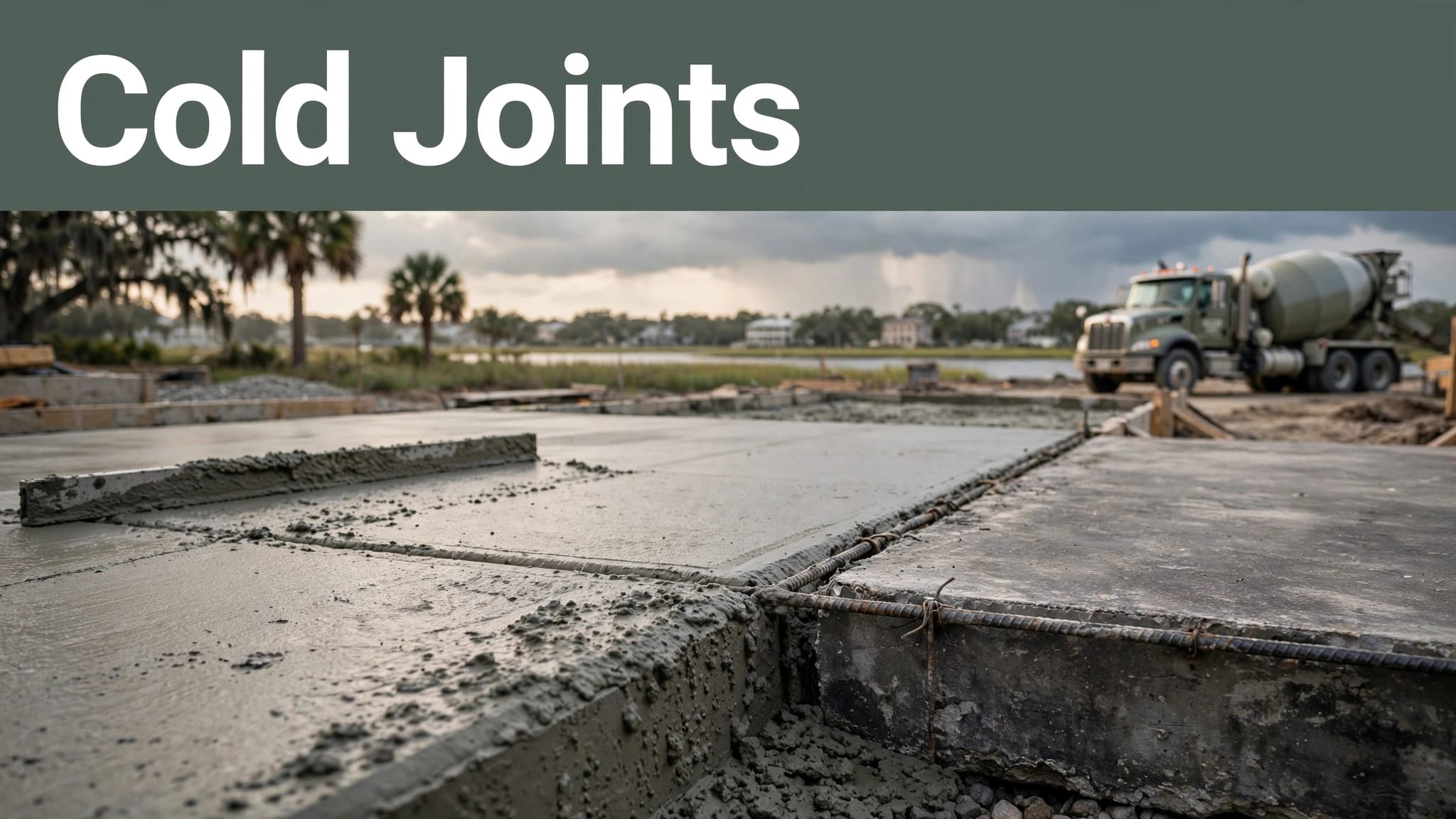
A cold joint is an unplanned separation between two placements of concrete. It forms when the first load stiffens before the next arrives, so successive concrete batches no longer intermingle or bond properly.
The ACI’s concrete-joint definition centers on that loss of intermingling after a placement delay. The seam may be obvious, or it may remain hidden beneath a finished surface until cracking or leaks appear.
What the seam looks like
On a driveway, patio, or slab, the seam may appear as a straight line with a different texture or color. In vertical concrete, it can show as a horizontal seam, exposed aggregate, voids, or honeycombing. These signs may indicate poor consolidation or an irregular interface, but they don’t prove structural failure by themselves.
This unplanned seam differs from ordinary surface crazing. Crazing produces shallow, random hairline marks, while a placement boundary follows the meeting line between successive placements or lifts. A planned joint is intentionally located and detailed for the placement sequence, so it isn’t interchangeable with this unplanned interface.

Why it happens during placement
Fresh concrete has limited workability, and a stiffened surface may develop a weak, milky layer called laitance. Laitance alone doesn’t prove a defective interface, but it can reduce bond potential when new concrete arrives.
Delivery gaps are a common trigger. So are an undersized crew, a pump issue, poor access for wheelbarrows, slow batching, or trying to place too much concrete with too little equipment. Weak consolidation makes matters worse because concrete never fully closes around steel, corners, or aggregate.
Charleston Weather Can Shrink the Working Window
Charleston’s climate demands careful timing because high concrete temperature, direct sun, hot forms, and wind can accelerate slump loss and setting. Travel time and placement rate can further shrink the available working window. High humidity may slow surface evaporation, but it doesn’t stop hydration or guarantee workability.
Research on cold-joint formation in hot weather found that joints form when the next layer arrives after the earlier layer’s vibration limit. The next layer must arrive while the previous layer can still be properly consolidated. Otherwise, vibration may disturb concrete that has already started to set.
Hot-weather pour problems to plan around
A crew must account for concrete temperature, travel time, access, staffing, truck coordination, and placement rate. Starting a large slab late in the day can help, but only if lighting, staffing, and ready-mix scheduling remain solid.
A retarding admixture may extend the working window when approved by the concrete supplier or mix designer. It doesn’t replace adequate staffing, truck coordination, or proper consolidation.
Rain deserves equal attention. Light rain can damage a fresh finish, while a hard storm may stop placement altogether. Set a weather decision point before trucks arrive, keep protective covers ready, and protect the subgrade and forms from runoff. If heavy rain arrives, stop or reschedule safely rather than trying to finish through it. Use weather protection afterward to support initial concrete curing.
As an illustration, a 20-minute delay can be manageable early in a pour, but the same delay near the end can create a visible seam when the first section has already tightened. It isn’t a universal safe delay, because actual timing depends on weather, mix, and placement conditions.
Preventing Cold Joints During Concrete Placement
Preventing a cold joint starts before the first truck arrives. A qualified Charleston SC concrete contractor confirms volume, delivery intervals, crew assignments, access, pump or buggy logistics, and finishing capacity. The plan includes weather contingencies, a safe stopping point, and a delivery pace that keeps each section placed and consolidated.
For small residential construction placements, manual mixing suits repairs, isolated posts, or a limited landing. Larger slabs and foundations usually need ready-mix concrete, since a full slab on grade moves faster than bags can be mixed. A half-finished slab doesn’t wait politely while another bag mixes.
Schedule trucks around the actual placement rate
Estimate the crew’s hourly placement and consolidation rate, then schedule concrete batches around it. Coordinate truck timing and mix temperature with the concrete supplier, but keep site readiness under the crew’s control. The first truck shouldn’t discharge its full load into a corner if the crew can’t move it promptly.
The placement sequence should avoid trapping workers or equipment. Begin at the farthest point and work back toward access, with clear routes for chutes, buggies, and a pump hose. If a truck is late, the crew can manage the leading edge before it loses its plastic state.
Consolidate each lift while it is fresh
Place concrete in manageable lifts and use vibrator compaction when the design and element call for it. Insert the vibrator vertically at regular spacing, using a brief dwell time in overlapping zones. Never drag it sideways, since that can separate aggregate and create more defects.
A vibrator can’t fix a layer that has already stiffened. Continued vibration may weaken the surface rather than restore a bond. If a delay becomes unavoidable, follow the engineer’s instructions or the plans’ procedure for a stopping point, rather than improvising.

Planned Joints Are Different
A construction joint is intentional. The plans identify its location, reinforcement or load-transfer details, surface preparation requirements, and placement sequence. It allows work to stop where the concrete element can transfer loads as designed.
Unplanned seams lack those details. They can occur anywhere the crew loses continuity.
When a joint can be acceptable
Some nonstructural flatwork may tolerate an unintended interface, but appearance, moisture, load, reinforcement continuity, geometry, and movement still matter. A visible seam in decorative flatwork may be an aesthetic defect if it disrupts an otherwise clean pattern.
An unexpected interface in a foundation wall, retaining element, suspended slab, beam, loaded footing, or commercial floor needs more scrutiny. The engineer of record should evaluate unexpected interfaces in structural concrete. Don’t assume reinforcement alone makes every seam safe.
For new work, ACI 318 requires construction joint surfaces to be cleaned and laitance removed before new concrete is placed. Plans may specify keyways for load transfer or shear resistance, but they’re not automatic. The STRUCTURE magazine’s review of concrete-joint preparation explains why a clean, roughened interface matters to bond performance.
Monolithic footings and slabs
Engineers may prefer a monolithic pour when a footing and slab must act together. It may reduce interfaces and preserve reinforcement continuity, but details depend on plans, soil, reinforcement, and load path.
In South Carolina, applicable residential construction requirements may reference adopted code provisions or ACI 332 for slabs-on-ground. They may also address dowels where a slab isn’t cast monolithically with the footing. Confirm current requirements, approved plans, and Charleston County inspection procedures before the truck arrives. Check whether slab and under-floor inspections are required after reinforcement and embedded services are installed, but before placement begins.
How to Assess an Existing Cold Joint
Start with a close visual inspection. Look for a straight crack, crumbling edge, rusty staining, moisture, exposed steel, honeycombing, or a change in elevation across the seam. Tap lightly with a hammer handle. A hollow sound can suggest poor bonding or delamination, but these checks can’t establish structural capacity alone.
Document the seam before patching it. Take photos after rain and note whether the crack widens, leaks, or changes height. Those clues help distinguish a surface defect from movement in the slab or supporting soil.
Cosmetic seams and water intrusion
A sound but unattractive seam may be an aesthetic defect. It may need only a surface repair or an overlay system suited to the application. For a stamped concrete patio in Charleston, color hardener, release patterns, and control joints complicate spot repairs. Matching texture, color, aggregate appearance, and pattern often takes more skill than filling the line.
For a concrete driveway in Charleston, SC, a seam that opens or spalls under vehicle traffic needs prompt attention. Water entering the seam can soften supporting material and worsen edge damage over time. Moisture at the seam may also signal poor drainage, crack movement, or a concrete-interface problem.
Caulking has a limited role. Flexible sealant can block water at a moving, nonstructural crack after proper cleaning and joint preparation. It can’t bond two poorly connected placements into one structural element.
A sealed seam may stay dry at the surface, but sealant doesn’t replace missing consolidation, reinforcement, or concrete-to-concrete bond.
Structural repairs require a design
A seam affecting a footing, foundation wall, load-bearing slab, or commercial floor may indicate a structural issue. Call the project engineer or a licensed structural engineer. Testing may help characterize compressive strength, but it doesn’t establish interface bond or overall structural adequacy by itself. Depending on the cause, they may recommend testing, selective removal and replacement, added reinforcement, or a designed injection or repair detail.
For a planned repair, workers commonly saw-cut or chip to sound concrete, remove laitance, roughen the surface, and clean it thoroughly. Drying requirements depend on the selected repair material. Workers may add keyways or dowels when the repair design requires them. Bonding agents can improve adhesion in a compatible repair system, but they can’t replace sound-concrete preparation, required reinforcement, or engineering design. Keyways are used only when the repair design calls for them, and they aren’t a universal cure. This cold-joint repair overview describes common bonding-agent options and preparation steps.
Placement Quality Matters Across Charleston Projects
Placement planning applies to more than foundations. A small residential pour may use less concrete, but a visible seam can still shorten service life or spoil the finish.
Slabs, driveways, patios, and pool decks
During a concrete slab installation in Charleston, the base must be compacted, forms secured, and reinforcement supported. Embedded items, truck access, and the finishing crew should be ready before delivery begins. Required thickness depends on code, plans, soil, loads, and intended use.
Pool deck concrete in Charleston needs special attention because splash water and wet feet expose seams quickly. Slope, drainage, coping details, and a controlled joint layout help manage moisture and limit water-related damage.
A Lowcountry concrete contractor should also plan decorative work around the fresh concrete window. Broom finishes, stamped patterns, textured surfaces, and colored surfaces need timely finishing. Delays can affect pattern consistency and final texture.
Tabby and specialty finishes
Traditional tabby concrete in Charleston uses oyster shell aggregate and has its own visual character. It still requires consistent batching, placement, consolidation, sound drainage, and the specified curing and protection process.
Shell-rich material can make texture and color differences especially visible. The same principle applies to commercial sidewalks, driveway aprons, and outdoor hardscapes.
Good preparation and a realistic placement plan beat a last-minute patch every time. For project options beyond foundations, see these Charleston concrete slab and foundation services and practical Charleston concrete advice.
Frequently Asked Questions
What causes a concrete cold joint?
A concrete cold joint forms when there is enough delay between placements for the earlier concrete to stiffen. Delivery gaps, hot weather, pump problems, limited staffing, poor access, and slow consolidation can all contribute.
Are concrete cold joints always structural problems?
No. Some seams in nonstructural flatwork may be mainly cosmetic or related to water intrusion. An unexpected interface in a foundation, retaining element, suspended slab, beam, footing, or commercial floor needs evaluation by the project engineer or a licensed structural engineer.
How can cold joints be prevented during a pour?
Plan the placement rate, truck schedule, crew assignments, access, equipment, weather response, and safe stopping point before delivery begins. Place manageable lifts and consolidate each one while the concrete remains fresh.
Can a vibrator fix a concrete cold joint?
A vibrator can help consolidate fresh concrete, but it cannot restore a layer that has already stiffened. Continued vibration may disturb or weaken the surface, so an unavoidable interruption should be handled according to the plans or an engineer’s instructions.
Can caulk repair a concrete cold joint?
Flexible sealant may help block water at a moving, nonstructural crack after suitable cleaning and preparation. It cannot restore concrete-to-concrete bond, missing reinforcement, or the structural capacity of a poorly connected placement.
A Better Pour Starts Before the First Truck
Unplanned seams and placement interruptions are preventable when timing guides the build. Ready subgrade and reinforcement, coordinated deliveries, and continuous placement reduce avoidable delays. Thorough consolidation, weather planning, and proper protection after placement help the work perform as one piece.
An existing seam deserves an honest assessment before anyone reaches for caulk or patch material. If you are planning a new slab, patio, driveway, pool deck, or foundation, Get a Free Quote and start with a placement plan built for Charleston conditions.