Charleston’s sticky summer air can fool people into thinking fresh concrete will take care of itself. Yet concrete curing compounds still matter because heat, direct sun, wind, and a warm slab can pull moisture from the surface faster than hydration can use it.
A driveway, patio, or slab gets one chance to cure correctly. The right material and timing help it gain strength, resist surface dusting, and look more even for years.
Why Charleston Humidity Does Not Cure Concrete by Itself
Concrete hardens through hydration, a chemical reaction between cement and water. Humid air can slow surface evaporation, but it does not replace proper curing.
Charleston’s humid subtropical weather also brings hot afternoons, sudden rain, coastal breezes, and intense sunlight. Those conditions can shift during a single placement.
Heat and wind still pull moisture from the slab
Concrete temperature matters as much as the weather app’s air temperature. A dark form, exposed aggregate, or sun-baked base can raise the slab’s surface temperature before the crew finishes it.
Wind strips away the thin humid layer above fresh concrete. As a result, moisture can leave the surface even when the relative humidity feels high. The Federal Highway Administration advises extra plastic-shrinkage precautions when evaporation exceeds 1.0 kg per square meter per hour in hot conditions, as outlined in its concrete curing guidance.
Humidity reduces one drying pressure. It does not cancel the effects of sun, wind, hot concrete, or delayed curing.
Surface problems often start early
Plastic shrinkage cracks can appear while concrete is still fresh. They are usually shallow, but they can make a new surface look aged before it has even opened to traffic.
Rapid moisture loss may also lead to dusting, weak edges, and uneven color. A concrete contractor in Charleston, SC, should watch the concrete, not only the forecast. Air temperature, wind speed, slab temperature, cloud cover, and finishing pace all affect the curing plan.
How Concrete Curing Compounds Retain Moisture
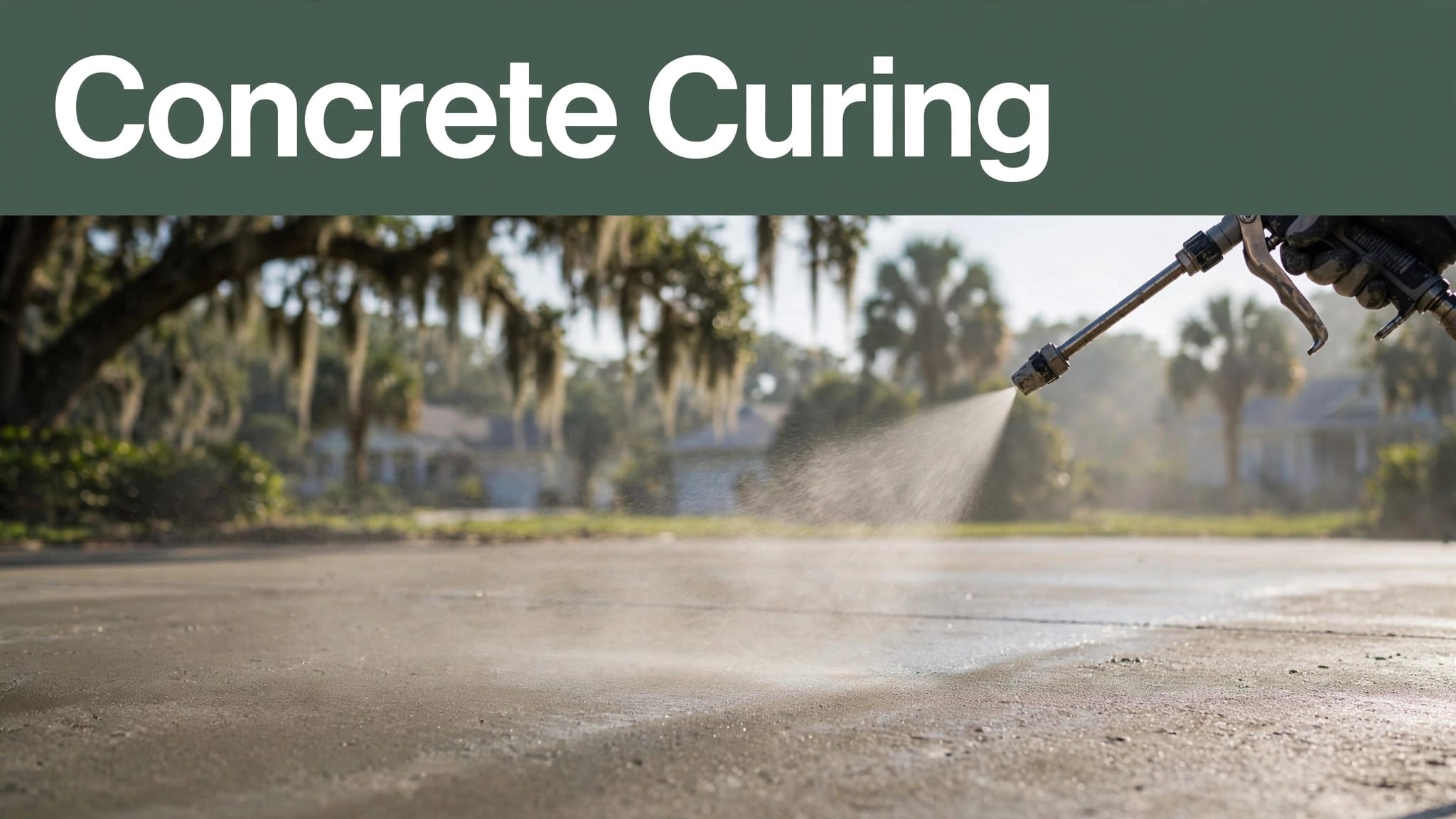
Liquid membrane-forming concrete curing compounds create a thin film over the finished surface. That film slows water loss so the cement has moisture available for continued hydration.
They are especially useful when continuous wet curing is impractical for a broad driveway, a commercial slab, or a large patio. However, a compound works only when the crew applies it at the right point.

Timing comes after finishing and bleed water
A crew should wait until finishing is complete and free water has left the surface. Applying a membrane too early can trap bleed water and interfere with the finish. Waiting too long allows avoidable moisture loss.
The material must cover the surface evenly, including edges and tight areas near forms. Thin spots become weak points in the moisture barrier. Product instructions set the application rate, and the crew should use calibrated spray equipment rather than guessing.
ASTM C309 gives homeowners a useful benchmark
For many exterior flatwork projects, contractors choose curing materials that meet ASTM C309, the standard for liquid membrane-forming curing compounds. ASTM C309 products are tested for moisture retention. A curing-compound guide from Dayton Superior lists a maximum moisture loss of 0.55 kg per square meter over 72 hours for that standard.
That rating does not make every product right for every finish. It does give the homeowner a clear question to ask: Does the specified material meet ASTM C309, and is it compatible with the planned surface treatment?
Choosing Concrete Curing Compounds for the Finish
The curing product has to match the job’s appearance and long-term use. A functional broom-finish slab has different needs than a decorative surface that will receive color, sealer, or another bonded material.
A local crew should decide this before the truck arrives. Changing products after concrete is down is rarely a good fix.
Clear, white-pigmented, and dissipating materials
White-pigmented compounds can reflect sunlight, which helps limit heat buildup on exposed concrete. The FHWA includes white or gray pigmented membrane compounds in its curing-compound recommendations for surfaces exposed to sun.
Clear compounds may suit projects where a white film would be undesirable. Dissipating or removable products may fit surfaces scheduled for a compatible sealer or coating. Each option has limits, so the label and finish schedule matter more than a generic product preference.
Decorative work needs a compatible system
A stamped concrete patio in Charleston needs careful coordination between color hardener, release agent, curing approach, cleaning, and sealer. Some curing membranes can affect sealer adhesion or alter the final color if the product combination is wrong.
The same caution applies when an overlay, tile, epoxy, or another concrete placement must bond to the surface. Curing compounds may not belong on concrete that will receive a bonded finish. Discuss that plan before placement, then follow the selected product’s instructions without substitutions.
Plan the Pour Around Lowcountry Weather
A strong curing plan starts before the ready-mix truck reaches the site. Charleston rain can arrive quickly, and a humid morning can turn into a hot, breezy afternoon.
Scheduling early can help, but it is not an automatic answer. The crew still needs shade, enough hands for finishing, curing materials on site, and a rain response.
Check field conditions, not only the forecast
For a concrete driveway in Charleston, SC, the installer should monitor the conditions at the actual site. A protected backyard can behave differently than an open driveway near the coast.
Before placement, the crew should confirm:
- The curing compound is on site, mixed if required, and ready for the specified application rate.
- Forms, base, reinforcement, drainage details, and access are complete before the concrete arrives.
- Rain covers are available without letting plastic touch and mar fresh concrete.
- The finishing crew has a clear sequence for final passes, curing, and site protection.
Rain changes the plan, not the need for curing
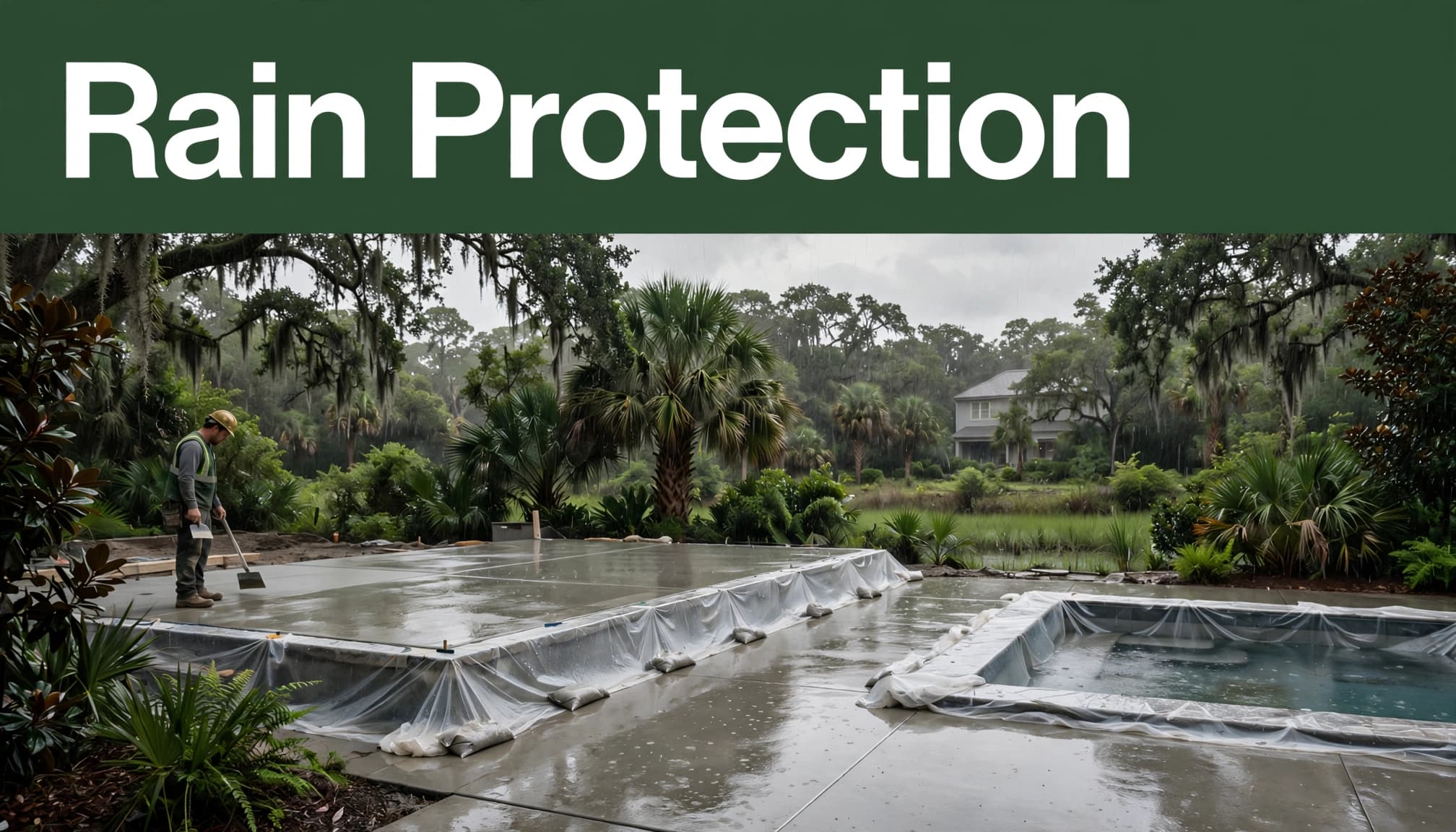
Rain before the concrete sets can damage the paste at the surface, leaving weak or blotchy areas. Crews should not work rainwater into the slab or dust a wet surface with dry cement to force a finish.
After the final finish and curing application, rainfall still deserves attention. A membrane compound reduces evaporation, but it does not protect uncured concrete from physical damage, runoff, or debris. Protect the placement without trapping heat or touching the tender surface.
Match the Curing Method to the Concrete Project
Every concrete surface faces moisture loss, but traffic, texture, color, and exposure change the best approach. A Lowcountry concrete contractor should explain how curing fits the exact project instead of treating all flatwork alike.
Driveways, slabs, and commercial flatwork
A concrete slab installation in Charleston often covers enough area that wet burlap or continuous sprinkling is hard to manage. A properly selected membrane compound offers practical moisture retention across large, uninterrupted surfaces.
Driveways also face tire traffic, runoff, and hot sun. The contractor should set realistic expectations for use. Fresh concrete needs protection from vehicles, sharp loads, and heavy equipment while it develops strength. The full range of Charleston concrete services includes the driveway, slab, patio, and commercial work where that planning pays off.
Pool decks, patios, and tabby surfaces
Pool deck concrete in Charleston must handle bare feet, splash water, and strong sun. A slip-resistant texture and a curing system that suits the sealer plan are both part of a durable result.
Traditional tabby concrete in Charleston adds another consideration. Its oyster-shell character gives it a distinctly Lowcountry appearance, so surface color and texture deserve extra care. The same hydration principles apply, but a compatible cure protects the intended finish.
Avoid Shortcuts That Leave Permanent Marks
Curing is not the last-minute step at the end of a pour. It is part of the placement plan, along with subgrade preparation, mix design, finishing, joints, and weather protection.
Do not mistake a wet-looking surface for proper curing
A slab can look damp in Charleston’s morning air and still lose water quickly later in the day. Likewise, spraying water once after the crew leaves does not provide steady moisture control.
FHWA guidance commonly calls for seven uninterrupted days of curing, with adjustments based on the concrete mixture and verified strength development. A membrane compound helps create the right environment, but it cannot correct poor finishing or weak site preparation.
Do not apply the wrong product at the wrong rate
Overapplication can leave residue and affect later coatings. Underapplication leaves gaps in the membrane. Uneven spraying often shows up as uneven curing.
Ask the contractor which curing product is planned, whether it meets the job specification, and how it works with the final finish. A clear answer is a good sign that the project has been thought through. If you are planning work, Get a Free Quote before locking in a pour date.
A Better Cure Gives Charleston Concrete a Better Start
Charleston’s humidity helps slow evaporation, but it cannot carry a new slab through curing on its own. Heat, wind, sunlight, rain, and the selected finish still demand close attention.
The strongest results come from prompt, compatible concrete curing compounds, careful application, and protection suited to the weather. That early discipline helps concrete look cleaner and perform better long after the forms come down.