
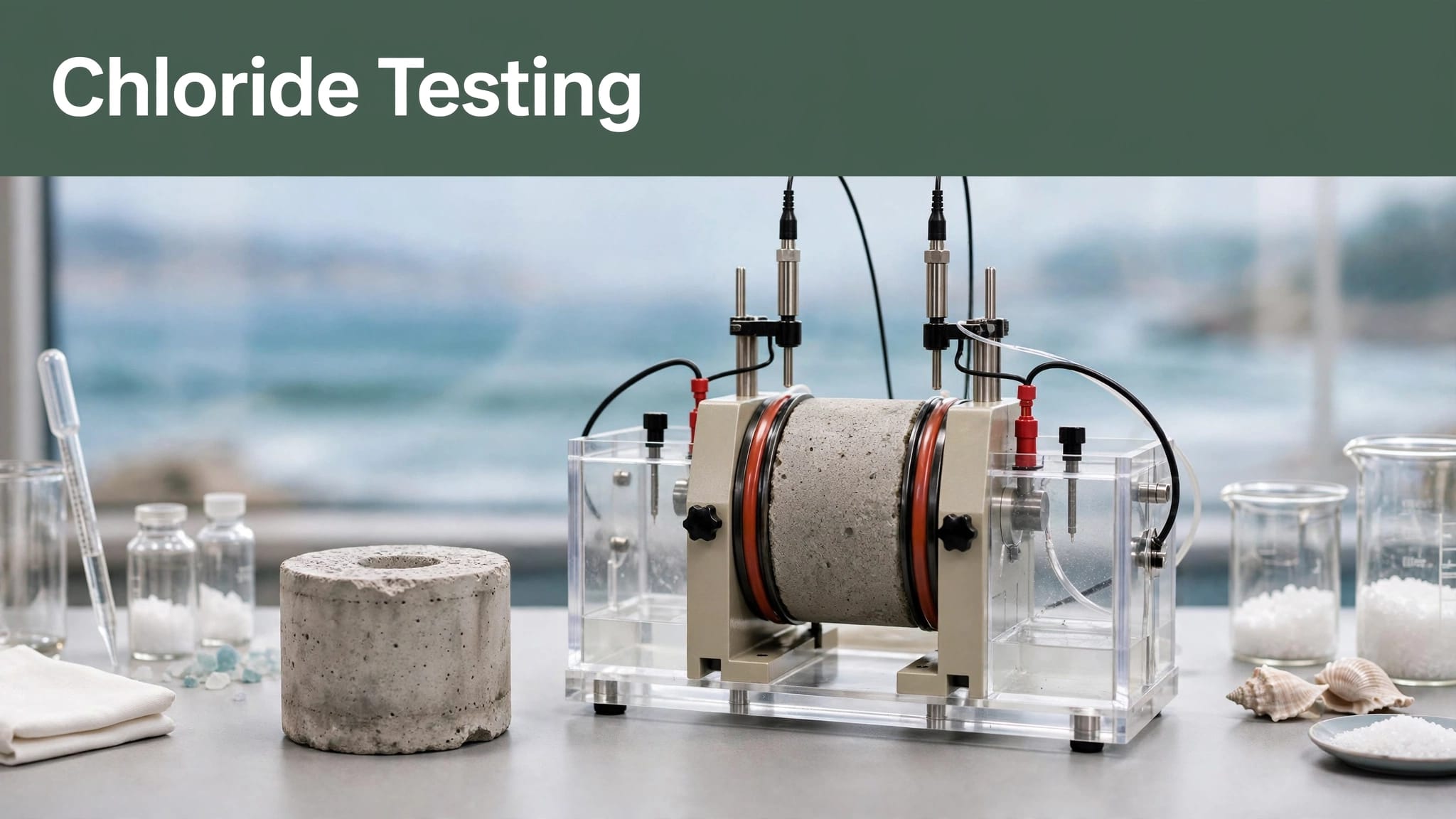
A rapid chloride permeability test measures electrical charge passing through hardened concrete to indicate its resistance to chloride penetration. For Charleston properties exposed to salt-bearing moisture, it can help evaluate a concrete mixture’s durability, but it doesn’t predict a slab’s lifespan.
A smooth finish or passing strength test can’t tell you how readily chlorides may move toward reinforcing steel. Understanding what this laboratory test measures starts with separating coastal exposure, concrete quality, and the test result itself.
Key Takeaways
- ASTM C1202 evaluates electrical conductance, providing an indirect indication of resistance to chloride penetration.
- Lower charge readings generally indicate greater resistance, but specimen age, curing, and mixture ingredients affect the result.
- Testing supports material selection and quality control. It doesn’t replace drainage, adequate concrete cover, controlled placement, or maintenance.
Why Coastal Concrete Needs Chloride Resistance

Chlorides can reach reinforcing steel
Concrete contains connected pores that allow moisture and dissolved salts to move through it. Cracks can provide additional pathways.
When enough chloride reaches embedded steel, it can disrupt the protective conditions that normally limit corrosion. With moisture and oxygen available, corrosion products expand and push against surrounding concrete. Rust staining, cracks following reinforcement, and spalling can follow.
Charleston’s marine exposure makes this relevant, although direct tidal splash creates different conditions than occasional airborne salt farther inland.
Surface damage needs a separate diagnosis
Pitting and flaking don’t automatically prove chloride-driven reinforcement corrosion. Weak surface paste, poor finishing, abrasion, and other exposure conditions can produce similar symptoms.
Repeated wetting also gives salt-bearing moisture more opportunities to enter vulnerable areas. Standing water along a driveway edge deserves attention even when the concrete initially tested well.
A concrete driveway in Charleston, SC, therefore needs both suitable materials and effective runoff management. A chloride-resistance result can’t explain every surface defect or compensate for ponding.
How the Rapid Chloride Permeability Test Works
ASTM C1202-19(2025) describes the laboratory method commonly called RCPT. Testing uses a prepared, hardened specimen rather than fresh concrete beside the truck.
Preparing the concrete specimen
The laboratory typically uses a disk approximately 100 millimeters in diameter and 50 millimeters thick, roughly 4 inches by 2 inches. Technicians cut it from a molded cylinder or a suitable core.
The specimen undergoes prescribed conditioning, including vacuum saturation. Its sides are sealed so the test focuses on electrical movement through the disk’s thickness.
Preparation matters because moisture condition, geometry, and specimen selection influence the reading. A laboratory sample also needs identification connecting it to the mixture or placement it represents.
Measuring charge over six hours
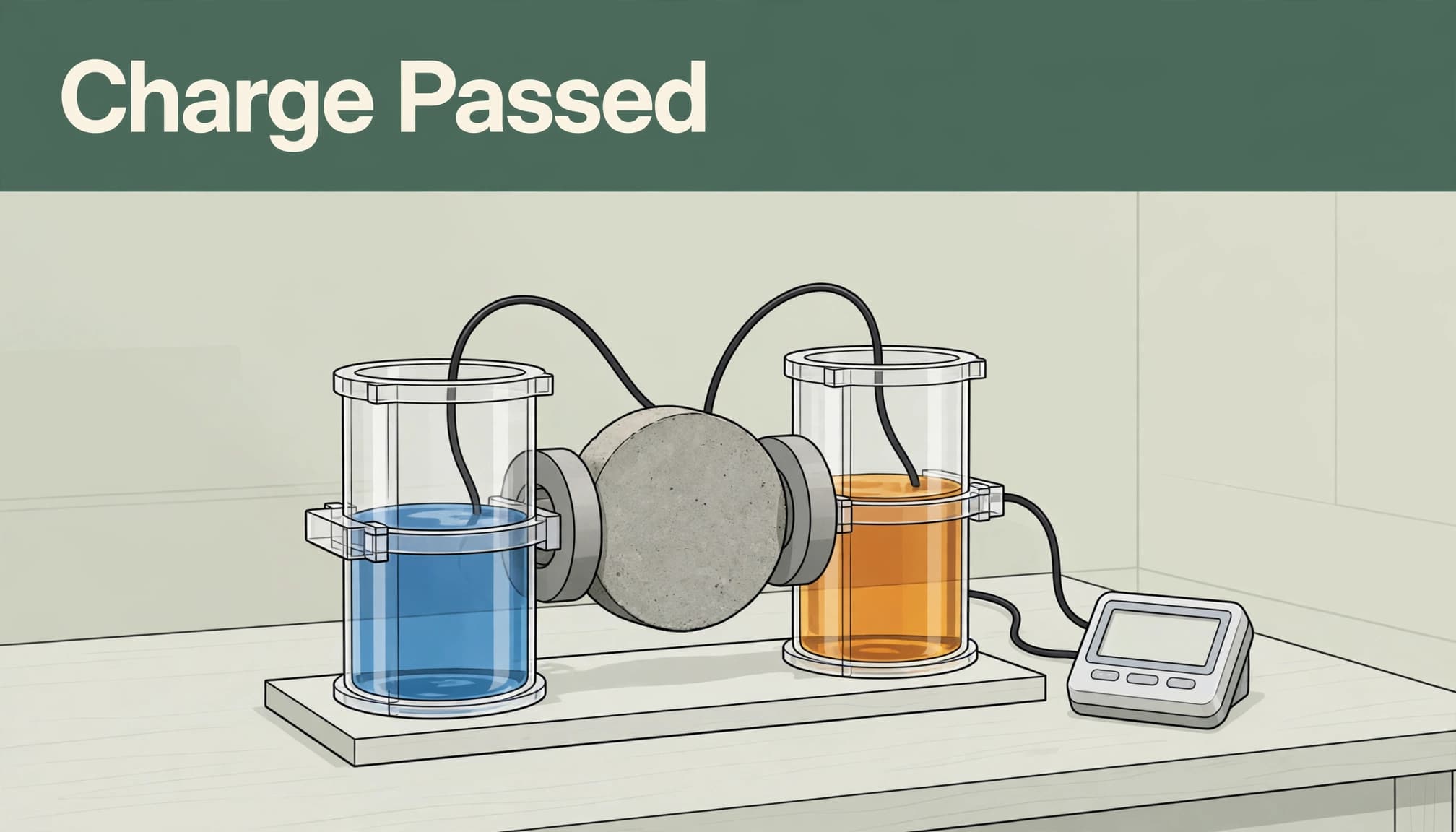
The disk sits between two solution cells. One contains 3% sodium chloride solution; the other contains 0.3-molar sodium hydroxide solution.
The apparatus applies 60 volts of direct current for six hours. Technicians record current and calculate the accumulated charge in coulombs.
The Federal Highway Administration’s concrete durability testing brief describes these test conditions. However, the six-hour electrical run excludes specimen curing, cutting, conditioning, and reporting, so “rapid” doesn’t mean an immediate pour-day answer.
Reading RCPT Results Without Overpromising
The familiar ratings describe qualitative chloride-ion penetrability based on charge passed. They aren’t direct measurements of water permeability or chloride diffusion.
The commonly reported categories are:
| Charge passed, coulombs | Qualitative penetrability |
|---|---|
| Greater than 4,000 | High |
| 2,000 to 4,000 | Moderate |
| 1,000 to 2,000 | Low |
| 100 to 1,000 | Very low |
| Less than 100 | Negligible |
FHWA’s chloride penetrability classification guidance presents these broad categories. Project specifications establish acceptance requirements, including test age and any numerical limit.
For comparable specimens tested under matching conditions, a lower result generally indicates greater resistance. However, “negligible” doesn’t mean completely impermeable.
A coulomb result describes the tested specimen under laboratory conditions. It doesn’t establish how many years a coastal slab will last.
The report needs context: specimen age, curing history, mixture identification, and sampling location. A number without those details provides a weak basis for comparing mixtures or judging installed work.
What Can Distort a Chloride Test Result
Concrete age and curing change the comparison
Concrete’s pore structure changes as hydration continues. Mixtures containing supplementary cementitious materials can also develop resistance differently over time.
Consequently, comparing specimens tested at different ages can create a misleading ranking. Poor specimen curing can further obscure whether a result reflects the intended mixture.
The testing plan should establish the age, conditioning, number of specimens, and acceptance criteria before sampling. For concrete slab installation in Charleston, those decisions belong alongside the mix and placement requirements, rather than after an unexpected report arrives.
Electrical conductance isn’t chloride movement alone
All mobile ions in the pore solution contribute to current. Chloride ions aren’t the only charge carriers.
Mixture chemistry and certain conductive ingredients can therefore affect the reading independently of chloride transport. The applied voltage can also heat the specimen during testing.
GCP’s explanation of ASTM C1202 helps distinguish electrical testing from actual chloride penetration.
Embedded steel or conductive fibers require particular attention. Surface treatments also need careful interpretation because RCPT may not describe their field benefit reliably. A sealer’s performance shouldn’t be judged solely by a coulomb reading.
When Charleston Projects Need RCPT
Engineered work and mixture qualification
RCPT is useful when project specifications require chloride-resistance evaluation, particularly for reinforced concrete facing meaningful salt exposure.
It can support mixture qualification before construction or quality-control testing during a specified program. Engineers may also use complementary transport tests when evaluating durability requirements.
The project documents determine sampling frequency, test age, and acceptance. A concrete contractor in Charleston, SC, should coordinate those requirements with the supplier, testing laboratory, and responsible designer before placement.
For existing structures, cores can support an investigation. However, chloride content, reinforcement condition, cracking, and exposure history may require separate evaluation.
Residential and decorative concrete
Every coastal patio doesn’t automatically need RCPT. The exposure, reinforcement, project specification, and consequences of deterioration determine whether testing provides useful information.
For a stamped concrete patio in Charleston, chloride resistance doesn’t establish stamp quality, color consistency, or surface durability. Charleston pool-deck concrete also needs appropriate texture and drainage, which this electrical test doesn’t measure.
Likewise, visible shells in tabby concrete in Charleston don’t establish the composition of the full mixture. Testing must represent the actual concrete.
Across our residential and commercial concrete services, the intended use matters more than assigning every project the same testing package.
Building Chloride Resistance Beyond the Lab
Control the mixture and protect curing
A suitable water-to-cementitious-material ratio helps limit connected porosity. Appropriate supplementary cementitious materials can also improve chloride resistance when the mixture receives adequate curing.
However, adding unplanned water during placement can undermine the approved mixture. Fresh-concrete slump measures consistency, not permission to exceed water limits.
Consolidation and curing also matter. Voids around reinforcement and prematurely dried surfaces create weaknesses that a favorable laboratory mixture result can’t repair.
Entrained air has a different purpose, primarily protecting suitably designed concrete against freezing and thawing. It isn’t a barrier that stops chloride entry.
Keep salt-bearing water moving away
Drainage reduces prolonged contact with contaminated moisture. Appropriate grading, functioning drains, and avoiding persistent wet edges all contribute to durability.
Specified concrete cover protects reinforcement by increasing the distance chlorides must travel. Crack management and suitable maintenance provide additional protection, but neither replaces proper detailing.
After exposure to salt spray, rinsing can remove surface deposits where runoff conditions allow. A compatible sealer may reduce moisture absorption, although its suitability depends on the finish and exposure.
A Lowcountry concrete contractor should address these practical details alongside material requirements. Rust stains, exposed reinforcement, and recurring spalls warrant assessment rather than repeated cosmetic patching. Structural deterioration needs a qualified design professional’s evaluation.
Frequently Asked Questions
Does passing RCPT prove concrete is strong?
No. Chloride-resistance testing and compressive-strength testing evaluate different properties. ASTM C39 measures the compressive strength of hardened cylinder specimens, while ASTM C1202 measures electrical charge through a conditioned disk.
A mixture may satisfy one requirement without satisfying another. The project specification determines which tests apply, and each result needs its own acceptance criteria. Neither result establishes that every part of an installed slab has the same condition as the sample.
Can RCPT show whether an existing slab contains salt?
It doesn’t directly measure the amount of chloride already present. Its primary purpose is indicating resistance to chloride penetration through electrical conductance.
An existing-slab investigation may instead need chloride-content testing at selected depths, reinforcement assessment, and inspection of cracks or delamination. RCPT can contribute information about sampled concrete, but it can’t independently identify the source of damage or prove that embedded steel is free of corrosion.
Is RCPT necessary for every coastal driveway?
A coastal address alone doesn’t create a universal testing requirement. Residential driveways commonly rely on project-specific mixture requirements, placement controls, and appropriate quality checks.
RCPT becomes relevant when a specification requires it or a durability evaluation calls for it. Drainage and curing still deserve attention regardless of whether laboratory chloride-resistance testing is included.
Match the Test to the Coastal Exposure
The rapid chloride permeability test provides useful information when the specimen, curing, test age, and acceptance criteria align. Its strongest role is supporting durability decisions alongside sound design and construction.
For Charleston concrete, the larger plan still includes controlled placement, reinforcement protection, and water management. If you’re planning a driveway, patio, pool deck, or slab, Get a Free Quote to discuss your property’s conditions and intended use.