

Concrete flexural strength testing measures how much bending stress a concrete beam withstands before breaking. For commercial pavements, that result helps evaluate whether the concrete meets the project’s specified resistance to bending.
A parking lot can look finished while its strength remains unknown. However, a dependable result requires proper specimen handling, a defined test method, and acceptance criteria tied to the pavement design.
Start with what the pavement carries, then connect the laboratory result to the construction requirements.
Key Takeaways
- Flexural testing reports modulus of rupture, a measure of concrete’s resistance to bending failure.
- ASTM C78/C78M uses third-point loading. Its results aren’t interchangeable with compression tests or results from a different beam-loading method.
- Sampling, curing, moisture condition, and handling affect beam results. Even a passing result doesn’t establish adequate slab thickness, sound drainage, or stable support.
Testing supports a pavement quality-control plan, but it can’t replace sound design or careful construction.
Why Commercial Pavement Needs Bending Strength
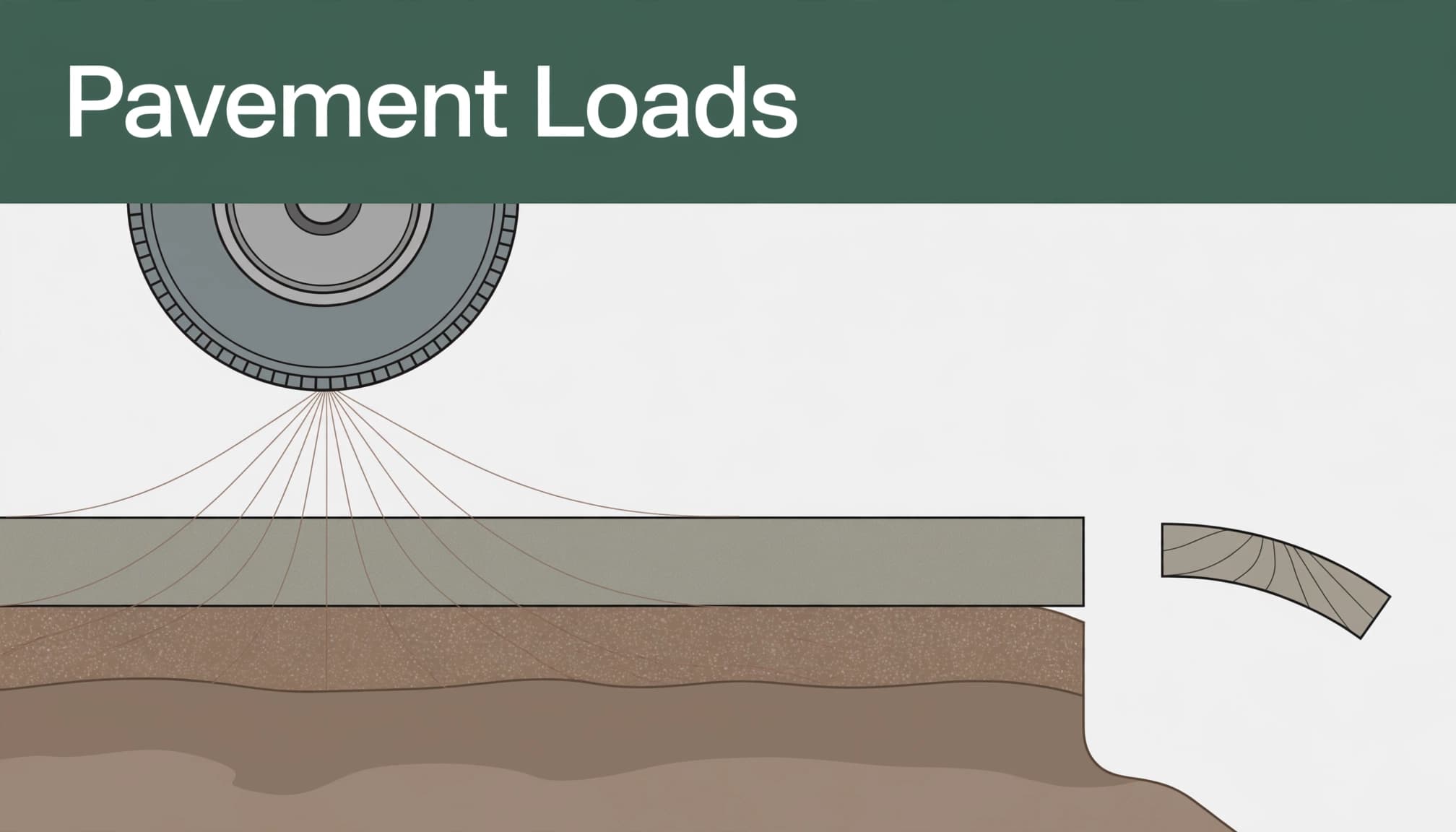
Wheel loads create tension within the slab
When a vehicle loads a concrete pavement, the slab bends slightly. That bending creates compression in some regions and tension in others. Because concrete resists compression better than tension, its bending resistance matters in pavement design.
Loading areas, truck entrances, and parking lots experience different loading patterns. Repeated heavy traffic also places demands on slab edges and joints.
Flexural strength gives the designer information about the concrete material. The pavement’s thickness, support, and joint arrangement determine how that material performs under traffic.
A strong mix still needs dependable support
A beam tested in a laboratory doesn’t reveal soft fill beneath a parking space. Likewise, it can’t identify water washing material away from a slab edge.
Charleston rainfall makes grading and drainage important before placement. If support changes after construction, a pavement can crack despite satisfactory strength results.
Our concrete installation and maintenance guidance addresses related construction concerns. Strength testing belongs alongside those decisions, rather than replacing them.
How Concrete Flexural Strength Testing Works
Third-point loading measures modulus of rupture
The ASTM C78/C78M test method evaluates a simple concrete beam using third-point loading. Two supports hold the specimen, while two loading points apply force within the span.
The laboratory increases the load until the beam fractures. It then calculates the modulus of rupture, commonly abbreviated MR, from the breaking load and specimen dimensions.
Results are commonly reported in pounds per square inch, or psi. Although compression tests also report psi, the two tests measure different behavior.
A common pavement specimen has a 6-by-6-inch cross section. However, specimen dimensions and preparation must fit the applicable procedure.

The fracture location affects the calculation
For a fracture within the middle third of the span, the calculation is:
MR = (P x L) / (b x d x d)
Here, P is the maximum applied load, L is the support span, b is the measured width, and d is the measured depth.
Fractures outside the middle third require different treatment under C78. Some permit an adjusted calculation; fractures beyond the method’s allowable location are discarded.
This makes the failure location part of the result. A report containing only the breaking load leaves out information needed to understand the test.
Protecting Beams From Sampling Through Testing
Representative sampling and curing serve different purposes
Test beams begin with a representative fresh-concrete sample. Records should connect that sample to the delivery, approved mixture, placement date, and pavement area.
ASTM C31/C31M addresses making and curing field specimens, including beams. Standard-cured specimens undergo controlled curing intended to evaluate the concrete’s strength under prescribed conditions.
Field-cured specimens have a different purpose. They help assess strength development under conditions associated with the work.
Those categories shouldn’t be mixed when interpreting results. A beam used for acceptance and a beam used to support a construction-timing decision may answer different questions. Assigning the purpose before placement prevents confusion later.
Moisture loss and rough handling distort results
Concrete develops strength through hydration, the reaction between cement and water. Drying doesn’t make it stronger.
Beam specimens are sensitive to moisture loss. Exposure to Charleston sun or coastal wind can change their condition before testing, even when the pavement itself receives adequate protection.
NRMCA’s CIP 16 guidance emphasizes preventing beam surfaces from drying. It also describes moisture conditioning before testing.
Transport deserves equal attention because impacts can damage specimens. Clear identification, protected storage, and documented curing help distinguish a material concern from a specimen problem. Those records become important when several placements share a testing schedule.
Reading Results Against the Pavement Specification
Compare the method, age, and curing condition
A strength number needs context. The report should identify the specimen, placement location, test age, curing condition, dimensions, maximum load, fracture location, and reported modulus of rupture.
The project specification supplies the acceptance criteria. Those criteria may address individual results, groups of tests, and the age at which strength is evaluated.
Loading methods also matter. ASTM withdrew its center-point method, C293/C293M, in 2025. This comparison of beam-loading methods describes that distinction.
Center-point results are generally higher than third-point results. Therefore, a C293 value can’t substitute for a C78 value or provide a dependable conversion.
Investigate a low result before deciding on repairs
A low beam result deserves a documented review. Begin with sample identification, curing history, transport, moisture condition, measured dimensions, fracture location, and testing records.
Next, compare the result with batch tickets, the approved mixture, and placement conditions. This helps separate possible testing problems from concerns about the concrete itself.
A low beam result doesn’t establish its cause; specimen history and placement records determine what needs investigation.
The engineer or designated acceptance authority should direct further evaluation when required. Neither immediate removal nor automatic acceptance follows from one unexplained number. The response belongs within the project’s established process.
Applying the Testing Plan in Charleston
Match commercial testing to the intended traffic
A retail parking space and a delivery-truck entrance don’t impose identical demands. Testing requirements should follow the pavement design, anticipated traffic, and contract documents.
For concrete slab installation in Charleston, identify the required method, specimen quantities, test ages, reporting responsibilities, and acceptance authority before delivery. Testing also needs space for protected specimens and coordination with placement.
We provide commercial concrete and pavement services for local projects. Defining the testing scope alongside the construction scope helps keep responsibilities clear.
A dependable Lowcountry concrete contractor should discuss those requirements plainly, without treating every pour as the same job.
Keep decorative and residential work in perspective
Flexural testing isn’t automatically required for every concrete driveway in Charleston, SC. Traffic, design requirements, and the contract determine whether beams belong in the testing plan.
Similarly, a stamped concrete patio in Charleston needs suitable preparation and curing, but its appearance doesn’t establish strength. Concrete pool decks also require attention to drainage, texture, and surrounding construction.
Tabby concrete in Charleston introduces shell aggregate into the discussion. The approved mixture and aggregate characteristics matter when selecting companion fresh-concrete tests.
A concrete contractor in Charleston, SC, should distinguish those project needs from a specification-driven commercial pavement acceptance program.
Frequently Asked Questions
Can cylinder strength replace a beam result?
A compression cylinder and a flexural beam measure different properties. ASTM C39 evaluates compressive strength, while C78 evaluates resistance to bending failure.
Concrete mixtures can have relationships between those properties, but an unrelated conversion chart doesn’t establish the flexural strength of a particular placement. Aggregate characteristics, mixture proportions, and curing affect that relationship.
If the specification requires beam testing, a cylinder result alone doesn’t satisfy that requirement. Likewise, a core taken from an existing slab generally provides a compression specimen, not the beam needed for a flexural test.
Does a passing result mean the pavement can reopen?
Permission to open pavement to traffic depends on the project’s opening criteria and the strength evidence required for that decision.
A standard-cured acceptance beam doesn’t automatically establish the pavement’s in-place strength at a particular hour. Field conditions, curing, and temperature affect strength development.
The intended load matters too. Pedestrians, passenger vehicles, and loaded commercial equipment place different demands on new concrete. Opening decisions should follow the project’s designated approval process, rather than surface appearance or a general waiting period.
Can an existing pavement undergo flexural testing?
ASTM C78 can be used with suitable sawed beams, as well as molded specimens. However, obtaining a beam from an existing pavement requires planning around slab dimensions, reinforcement, and the damage caused by removal.
The investigation should first define the question. Distress may involve support loss, inadequate thickness, deterioration, or joint problems rather than insufficient flexural strength alone.
An engineer can select testing that addresses the suspected cause. A beam result won’t describe every condition across an existing parking lot.
Build the Testing Plan Into the Pavement Plan
Concrete flexural strength testing is most useful when representative specimens, controlled handling, and clear acceptance criteria support the result. A reliable number needs a reliable record.
For Charleston pavements, that evidence belongs alongside suitable thickness, stable support, drainage, and curing. Together, those measures provide a stronger basis for construction decisions.
Planning a commercial pavement or concrete replacement? Get a Free Quote to discuss the site, intended use, and construction scope before delivery day.