
Pool coping joints help a concrete deck meet the pool edge without forcing both structures to move together. Where a separate deck meets the coping, a planned isolation joint protects that connection while keeping the poolside transition neat.
Around Charleston pools, sun, splash water, and regular foot traffic make this small detail important to the whole deck. A clean-looking seam alone doesn’t tell you whether the connection can handle movement. Start with what the joint does, then consider its relationship to drainage, finishes, and repairs.
How Pool Coping Joints Separate the Deck and Pool
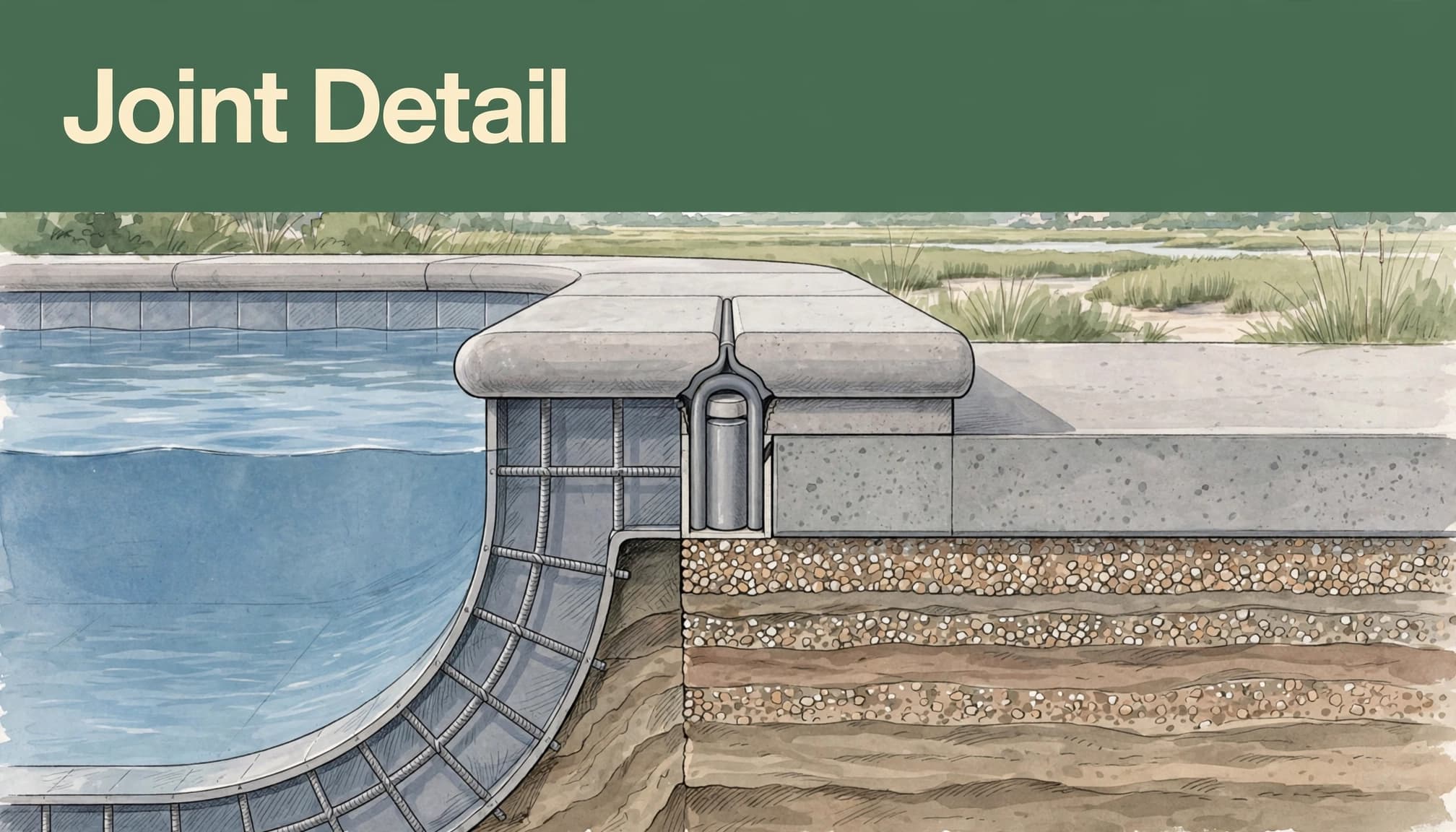
The coping caps the pool wall and creates the finished edge beside the water. The concrete deck provides the surrounding walking and gathering space. Although these surfaces meet visually, they don’t necessarily share the same support or movement.
The joint gives the deck room to move
Concrete changes dimensions as temperatures change, and new concrete also shrinks as it cures. A separate deck needs a connection that accommodates movement without transferring unnecessary pressure into the pool edge.
Pool Engineering’s guidance on concrete deck construction identifies isolation of deck movement from the coping and bond-beam assembly as the joint’s purpose. The bond beam is the structural upper portion of the pool wall.
The visible seam is only part of the detail
A tidy surface doesn’t prove that a joint provides separation underneath. Mortar, concrete, or other rigid material bridging an intended isolation joint can interfere with its function.
The connection also depends on the pool’s construction. Coping, its supporting assembly, and the adjacent deck need coordinated detailing. Treating the visible gap as a cosmetic line misses the movement issue that the joint addresses.
Isolation Joints and Control Joints Do Different Jobs
A saw-cut line across the deck isn’t automatically a substitute for separation at the coping. These joints solve different problems.
The National Ready Mixed Concrete Association explains in CIP 6, Joints in Concrete Slabs, that contraction joints create weakened planes to control where cracking occurs. Contractors also commonly call them control joints.
Here’s how the distinctions apply around a pool.
| Joint or seam | Main purpose | Poolside relevance |
|---|---|---|
| Isolation joint | Separates movement between adjoining elements | Helps keep deck movement independent of the coping assembly |
| Contraction joint | Encourages cracking at a planned location | Organizes shrinkage cracking within the deck |
| Coping-unit joint | Separates individual coping pieces | Belongs to the coping installation and its material system |
A deck can need both isolation and contraction joints. Adding saw cuts doesn’t correct a rigid connection at the pool edge. Likewise, renewing the perimeter joint doesn’t repair an inadequate contraction-joint layout elsewhere.
A clean saw cut in the deck doesn’t prove that the coping is isolated from deck movement.
The layout should make sense as a complete system, including corners, changes in shape, and transitions to other surfaces.
Charleston Pool Decks Need Movement and Drainage Planning
Pool deck concrete in Charleston faces direct sun, rain, splash-out, and repeated wet foot traffic. Movement planning matters, but it works alongside drainage and surface design.
Sun exposure affects the deck’s temperature
An exposed deck can warm substantially during a sunny afternoon. Shade changes that exposure, while lighter finishes generally absorb less solar heat than darker ones.
Those choices help with comfort, but they don’t remove the need for movement accommodation. A cooler-looking finish still sits on concrete that changes dimensions. Shade structures and furniture also shouldn’t hide a deteriorating perimeter joint from routine inspection.
The joint isn’t a drainage channel
Water should follow the planned deck slope toward the intended drainage route. A gap beside the coping shouldn’t become the place where puddles disappear.
Persistent ponding can leave residue and keep edges wet. Meanwhile, a sound-looking joint can’t correct a low spot in the deck. Drainage problems and joint deterioration may appear together, but each needs its own solution.
Concrete slab installation around a Charleston pool requires coordination among deck elevations, drains, coping, and access. Resolving those relationships before placement avoids trying to fix them through the finish afterward.

Plan the Joint Before Choosing the Finish
A well-planned joint can look intentional beside plain, stamped, or shell-rich concrete. Decorative work should accommodate that line rather than disguise it with rigid material.
Coordinate patterns without covering the joint
For a stamped concrete patio in Charleston that extends toward the pool, borders and pattern direction can help organize the transition. However, a decorative pattern doesn’t replace the underlying joint layout.
The same applies when coordinating a pool deck with a concrete driveway in Charleston, SC. Matching colors can connect the property visually, but the surfaces still need details suited to their different uses.
Tabby concrete in Charleston offers a regional oyster-shell appearance. Its texture and aggregate don’t change the purpose of separation at the coping. Decorative material shouldn’t bridge an intended movement joint simply to make the surface look continuous.
Balance appearance with barefoot comfort
A pool deck needs useful texture without harsh edges underfoot. Joint edges also deserve attention because swimmers cross them repeatedly.
Where a sealant system forms part of the detail, its appearance should complement the coping and deck. However, color alone isn’t a suitable basis for material selection. Outdoor exposure, movement, and poolside conditions matter too.
Our Charleston pool deck concrete services include standard and decorative finishes with slip resistance and drainage planning. Those practical requirements belong in the design alongside the joint.
Read the Warning Signs Before Repairing a Joint
Pool coping joints deserve attention when their condition changes. The useful distinction is between deterioration at the joint surface and movement affecting the adjoining concrete or coping.
Surface deterioration leaves visible clues
Where sealant is present, look for separation along its edges, splitting, missing sections, or areas that have hardened and broken apart. Dirt and plant growth can also conceal the joint’s condition.
Chipped concrete beside the joint deserves attention because a durable repair needs sound edges. Simply covering loose material leaves the weak area underneath.
White deposits or discoloration can accompany repeated wetting, but they don’t identify the cause by themselves. Cleaning may improve appearance without resolving the condition that produced the marks.
Displacement needs a broader assessment
Loose coping, rising deck edges, and cracks that continue beyond the joint suggest more than a cosmetic problem. An uneven transition also creates a trip concern around a wet walking surface.
Fresh joint material can’t stabilize a moving slab or secure a failed coping assembly. Significant displacement, loose pool-edge pieces, or damage involving the pool structure calls for professional evaluation.
For a business or managed property, restrict access to a hazardous section while the problem is assessed. A neat repair should never take priority over a stable walking surface.
What a Pool Coping Joint Repair Should Address
A lasting repair starts with identifying what failed. Weathered joint material, broken concrete edges, loose coping, and displaced deck sections require different work. Treating every condition as a caulking problem can leave the underlying damage untouched.
When the adjoining surfaces remain sound, renewing a deteriorated joint system may be appropriate. Preparation matters because dirt, residue, and loose material interfere with adhesion. Where sealant is part of the repair, it needs a suitable substrate and an installation detail that permits movement.
If rigid material bridges an intended isolation joint, covering it doesn’t restore separation. The repair needs to address that obstruction without damaging the pool edge or nearby components.
Broken edges may need concrete repair before the joint can be renewed. More substantial movement can require work beyond the joint itself. An overlay or fresh coating won’t correct an unstable connection.
As a Lowcountry concrete contractor, we offer pool decks alongside other residential and commercial concrete work. That scope helps homeowners consider the surrounding surface when planning the poolside project.
Our Charleston concrete advice also covers related planning and maintenance topics. The central repair principle remains simple: preserve the intended movement function rather than covering the visible symptom.
Keep Joint Maintenance Separate From Deck Cleaning
Routine cleaning provides a useful chance to notice changes around the coping. It shouldn’t become an aggressive attempt to blast deteriorated material out of place.
Pool splash can leave residue on both concrete and joint surfaces. Gentle cleaning suited to the installed materials helps remove buildup without treating the deck, coping, and joint as though they’re identical products.
Avoid directing concentrated pressure into an already damaged seam. Loose edges and failing material can deteriorate further under aggressive washing.
After cleaning, look for areas that remain wet, new separation, and changes in the height of adjoining surfaces. Comparing the same locations over time helps distinguish a persistent stain from a developing physical problem.
Deck sealer and joint material also have different jobs. Applying a surface coating across an intended movement joint doesn’t replace joint maintenance. Decorative resurfacing should preserve the joint’s function rather than bury it beneath a continuous finish.
Furniture placement matters as well. Keep recurring problem areas visible enough to inspect, particularly where shade and splash water make drying slower.
Key Takeaways for Charleston Pool Owners
The most useful pool-edge details combine movement planning with a comfortable, drainable walking surface.
- An isolation joint separates adjoining elements, while a contraction joint controls cracking within the deck.
- Decorative finishes should work with the joint layout instead of covering it.
- Ponding, damaged joint material, and displaced concrete need different repairs.
- Loose coping or uneven deck edges require attention beyond a cosmetic touch-up.
A concrete contractor in Charleston, SC, should address the connection as part of the surrounding deck, not as an isolated finishing detail.
Connect the Deck Without Restricting Movement
The strongest-looking poolside transition still needs room for movement. A planned joint, sound adjoining edges, and effective drainage help the deck meet the coping without creating unnecessary stress.
For an existing pool, the right repair follows the cause of the damage. For a new deck, the connection belongs in the plan before concrete placement and decorative finishing.
Get a Free Quote to talk with us about a concrete pool deck for your Charleston home or business.