Tabby concrete can give a Charleston driveway a look that standard gray concrete can’t match. Its visible oyster shells connect the surface to the Lowcountry’s coastal history, but the material still needs a driveway-grade design beneath the finish.
So, can tabby concrete be used for a driveway? Yes, when a qualified contractor builds it for vehicle loads, drainage, local soil, and coastal weather. The shell finish alone doesn’t make a driveway durable. Proper excavation, base preparation, reinforcement, concrete depth, joints, and curing matter just as much.
Before choosing tabby concrete, learn where it works well, where it may cause problems, and what to ask during your estimate.
Key Takeaways
- Tabby concrete can work for residential driveways when the mix and slab are designed for traffic.
- Oyster shells create a distinctive Lowcountry appearance, but they can produce a more textured, varied finish.
- Drainage and soil preparation are essential in Charleston’s wet, low-lying areas.
- A driveway may need different specifications than a patio, walkway, or pool deck.
- An experienced Charleston concrete services team can help compare tabby with standard and decorative concrete.
What Makes Tabby Concrete Different?
Traditional tabby is a cement-based material that includes oyster shells as aggregate. Historic examples appear throughout the coastal Southeast, including the Charleston area. Modern tabby concrete usually uses a controlled concrete mix with clean, graded shell added for its appearance and texture.
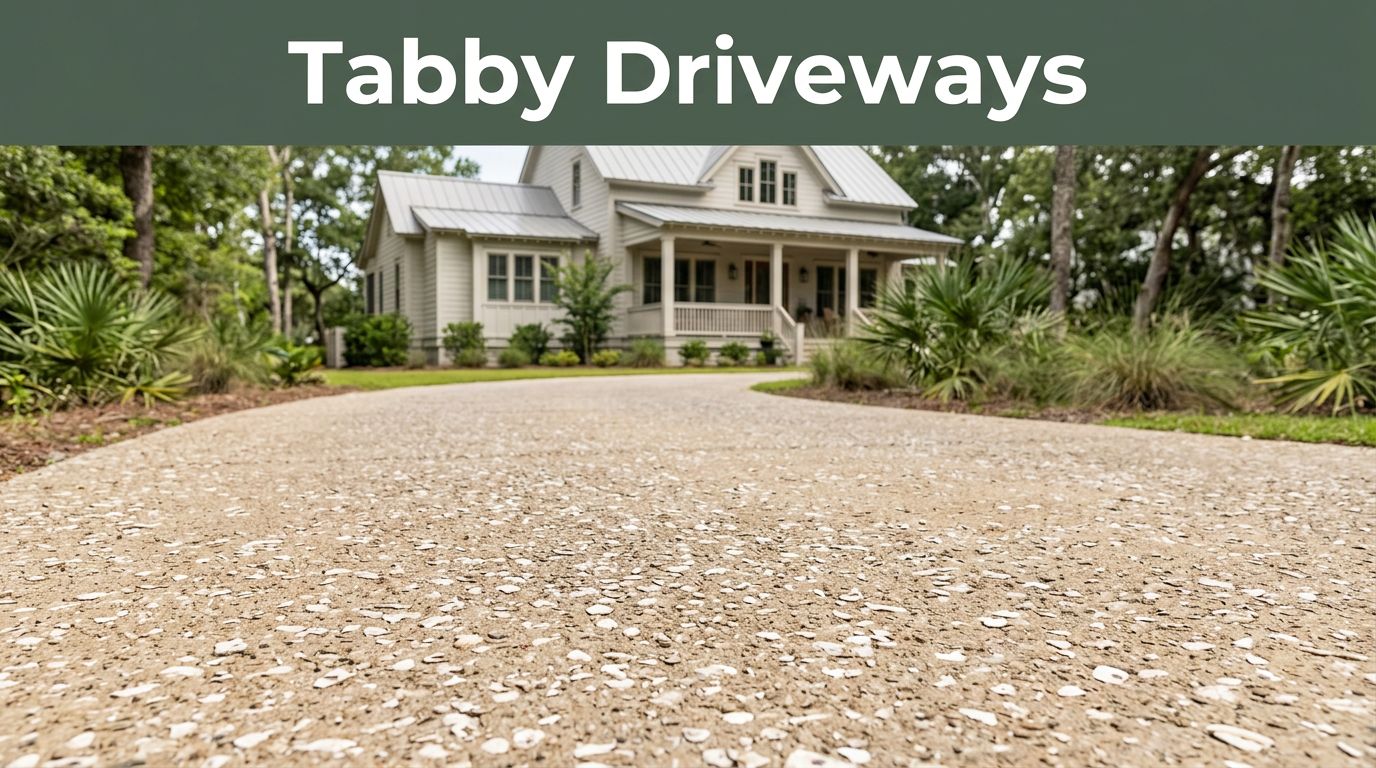
The shells may remain visible at the surface after finishing. Depending on the mix and placement method, the finished driveway can show small shell pieces, varied color, and a surface with more character than conventional concrete. That natural variation is part of the appeal, although it won’t look as uniform as a smooth broom finish.
For people researching tabby concrete Charleston, the local connection is clear. Oyster shells are part of the region’s building history, and tabby can complement homes with coastal, historic, cottage, or Lowcountry architectural details.
However, tabby isn’t automatically a stronger material than ordinary concrete. The slab’s performance comes from its concrete design and installation, not from the shells alone. A driveway contractor must select a suitable mix, place enough concrete for expected loads, and prepare the ground correctly.
The shell aggregate also affects the finished surface. Large or uneven pieces can create exposed spots, rough areas, or shallow voids if the crew doesn’t control the mix and finishing process. A sample panel can help you approve the expected appearance before work begins.
Is Tabby Concrete Strong Enough for a Driveway?
A properly designed tabby driveway can support normal residential vehicle traffic. Cars, SUVs, and light trucks place regular loads on the slab, so the contractor should treat the project as structural flatwork rather than decorative paving.
The most important details include:
- Subgrade preparation: Weak soil, organic material, and standing water must be addressed before concrete placement.
- Compacted base: A stable aggregate base helps distribute vehicle weight and reduces movement.
- Slab thickness: The required thickness depends on vehicle use, soil conditions, and site design.
- Reinforcement: Reinforcing steel or fiber reinforcement can help control cracking when included in an appropriate design.
- Control joints: Planned joints give the concrete designated locations to form natural shrinkage cracks.
- Curing: Concrete needs time and proper moisture control to develop strength after placement.
A driveway that regularly receives delivery trucks, work vehicles, trailers, or commercial traffic may need a heavier design. In those cases, the contractor may recommend thicker concrete, additional reinforcement, improved base work, or a different surface material.
The right question isn’t whether shells can appear in driveway concrete. It is whether the entire assembly is designed for the load and conditions at your property.
Tabby is a finish and material choice, but driveway durability starts below the visible surface.
If you are comparing options, ask for a written scope that identifies the planned base, slab thickness, reinforcement, joint layout, concrete mix, and curing process. Those details make it easier to compare estimates from a concrete contractor Charleston SC homeowners can trust.
Charleston Soil and Drainage Matter
Charleston driveways face conditions that can punish poorly prepared concrete. Many properties have soft or sandy soils, high groundwater, standing water, tree roots, and limited elevation change. Heavy rain can expose weak areas beneath a slab and send runoff toward garages, foundations, or neighboring lots.
A contractor should inspect how water moves across the property before setting grades. The driveway needs enough slope to drain without creating a steep transition at the street or garage. Existing ditches, swales, catch basins, culverts, and driveway aprons may affect the design.
Removing the topsoil is often necessary because organic material compresses over time. The exposed subgrade may then require grading, stabilization, or additional aggregate. Compaction should happen in controlled lifts rather than relying on a single pass over a deep layer of fill.
Drainage also affects the appearance of tabby. Persistent moisture can leave dirt, algae, and dark staining on a light-colored surface. Good slope and runoff control won’t prevent every stain, but they reduce the conditions that make cleaning difficult.
Charleston County and municipal requirements may also apply, especially when a project changes a sidewalk connection, curb cut, or public drainage path. Historic districts and neighborhood associations can have additional appearance rules. Confirm local requirements before demolition or concrete delivery.
An experienced Lowcountry concrete contractor will look beyond the driveway footprint. The design should account for the street connection, garage elevation, landscaping, downspouts, and nearby structures.
Appearance, Maintenance, and Everyday Use
Tabby concrete gives a driveway a warmer, more regional appearance than plain gray concrete. The color often depends on the cement, shell, sand, and finishing method. Some surfaces appear pale and sandy, while others show stronger shell contrast.
That variation can work well beside brick, stucco, wood siding, and coastal landscaping. It can also make repairs or extensions more noticeable. A new batch of tabby may not match an older section exactly because shell size, cement color, weathering, and finishing can differ.
The surface texture deserves attention. Light exposure can leave shells close to the surface, creating a rougher feel underfoot and more edges that collect dirt. A contractor should balance shell visibility with a surface that remains practical for walking, wheeling trash bins, and parking.
Routine care is straightforward:
- Sweep away leaves, sand, and loose debris.
- Rinse the surface when dirt begins to build up.
- Clean organic stains with a suitable concrete-safe product.
- Avoid harsh pressure washing that exposes aggregate or damages the cement paste.
- Keep irrigation and downspouts from sending constant water across the slab.
- Seal the surface only when the contractor recommends a compatible product.
Sealing can affect color, sheen, traction, and future maintenance. A glossy sealer may look out of place on a historic-inspired driveway and can become slippery when wet if the product and texture aren’t right. Ask for a low-sheen sample before approving it.
A tabby driveway won’t look perfectly identical across every section. Homeowners who appreciate natural variation usually find that quality attractive. Those who want a consistent, smooth gray surface may prefer standard concrete or a uniform decorative finish.
How Tabby Compares With Other Charleston Concrete Options
Tabby is one choice among several concrete surfaces available for Charleston properties. The best option depends on the home’s style, traffic, budget, maintenance expectations, and desired texture.
| Surface | Appearance | Common use | Main consideration |
|---|---|---|---|
| Tabby concrete | Shell-rich, coastal, varied | Driveways, walks, patios | Texture and batch variation |
| Broom-finished concrete | Simple, practical, consistent | Driveways and sidewalks | Limited decorative detail |
| Stamped concrete | Patterned to resemble stone or brick | Patios, entries, driveways | Needs careful coloring and sealing |
| Exposed aggregate | Stone-rich, textured | Walks, patios, pool areas | Can feel rough underfoot |
| Pavers | Individual units with joint lines | Driveways and hardscapes | Repairs are localized, but joints need care |
A stamped concrete patio Charleston homeowners choose may have patterns that imitate slate, brick, or cobblestone. That option offers more control over pattern and color, but the surface requires proper sealing and can show wear if the installation is poor.
For wet areas, pool deck concrete Charleston projects need attention to traction, drainage, and bare-foot comfort. Tabby can fit a coastal design, yet the contractor must control the surface texture so it doesn’t become unpleasant or unsafe around the pool.
A standard concrete driveway Charleston SC installation may provide the most predictable appearance and the simplest repair matching. Tabby makes more sense when regional character is part of the design goal.
The same decision applies to larger construction work. A concrete slab installation Charleston project may call for standard structural concrete, while tabby works better as a visible decorative surface in selected areas.
Questions to Ask Before Choosing Tabby
A clear estimate should answer more than the price per square foot. Ask the contractor how the driveway will handle your property’s specific conditions.
Useful questions include:
- How will you test or evaluate the existing soil?
- What material will you use for the compacted base?
- How thick will the driveway slab be?
- What reinforcement and control-joint layout do you recommend?
- How will the driveway drain toward the street or approved outlet?
- Can I see a tabby sample or a completed local project?
- How will you match a future addition or repair?
- What curing and sealing steps are included?
- Will the project affect a sidewalk, curb, ditch, or drainage easement?
- What traffic restrictions apply after placement?
Ask for references that involve driveways, not only patios. A decorative patio can have different load requirements and site conditions. The crew should also explain how it will protect nearby brick, siding, landscaping, and street pavement during demolition and placement.
Local experience has practical value. A contractor familiar with Charleston and surrounding communities understands that two properties a few streets apart can have different grades, drainage patterns, and soil behavior.
For more guidance on planning concrete work, review these Charleston concrete advice resources before requesting bids.
When Tabby May Not Be the Right Choice
Tabby may not suit every driveway. A highly textured surface can be inconvenient for homeowners who want easy snowless sweeping, smooth bicycle access, or a clean modern appearance. Matching an existing driveway can also be difficult if the original mix is unavailable.
Heavy commercial traffic is another concern. A busy business entrance, loading area, or construction access route may need a design focused on repeated high loads rather than decorative aggregate. In those settings, reinforced standard concrete or another engineered paving system may be more practical.
Drainage problems should be corrected before choosing any finish. Decorative concrete won’t fix a driveway that settles because water washes through the base. Likewise, tabby won’t prevent cracks caused by tree roots, unstable fill, or missing joints.
Budget matters too. Tabby may cost more than a basic broom finish because it can require custom aggregate selection, sample approval, specialized finishing, and more careful placement. Compare complete project scopes instead of comparing only material prices.
When the site is stable and the design fits the home, tabby can be a sound choice. When the site has unresolved water or soil problems, address those first.
Conclusion
Tabby concrete driveways can work well in Charleston when the contractor designs the slab for vehicle traffic and prepares the site for local soil and drainage conditions. Oyster shells add a distinctive Lowcountry appearance, but the concrete base, reinforcement, joints, and curing determine long-term performance.
Choose tabby when you want a regional finish with natural variation. Choose standard or stamped concrete when you need a more uniform appearance or easier matching. A detailed site review will show which option fits your property.
For a project-specific recommendation, request a Get a Free Quote that addresses both the driveway’s appearance and the structure beneath it.