Walk through Charleston’s oldest streets and you will notice something different about some of the walls, foundations, and paths. They have a rough, shell-flecked texture unlike anything you see in modern construction. That material is tabby concrete. And at Gorilla Concrete, it is one of our favorite things to talk about. It connects the Lowcountry’s past to the work we do today.
So, what exactly is tabby concrete? Where did it come from? And can you still use it today? Let’s break it all down.
What Is Tabby Concrete?
Tabby concrete is one of the oldest building materials in American history. It is made from a simple mix of lime, sand, water, ash, and crushed oyster shells. When it dries, it forms a hard, durable surface with a rough, natural texture.
The oyster shells are the key ingredient. They give tabby its look and its strength. Therefore, tabby has a very distinct appearance — speckled with white shell fragments and slightly uneven on the surface.
Furthermore, tabby is not a modern invention. People have been making it for centuries. In fact, some of the oldest structures in the American South were built with tabby concrete. Many of them are still standing today.
Because it was made from local materials, tabby was also practical. The Lowcountry had oyster shells in abundance. Builders used what they had, and what they had turned out to be remarkably strong.
The History of Tabby Concrete in the Lowcountry
Tabby concrete has deep roots in this region. Spanish missionaries first brought the technique to the southeastern coast in the 1500s. Over time, it spread throughout coastal Georgia and South Carolina.
By the 1700s, tabby was widely used in Charleston and the surrounding Lowcountry. Plantation owners, colonial builders, and free Black craftsmen all worked with it. Enslaved Africans, in particular, were central to tabby construction across the region. Their knowledge and labor built many of the structures that still exist today.
Additionally, tabby was used for everything. Forts, homes, churches, outbuildings, and garden walls — all built with the same basic shell-and-lime mix. You can still see tabby in Fort Frederica on St. Simons Island and in structures across the South Carolina coast.
Moreover, the technique survived because it worked. Tabby handled the humid Lowcountry climate well. It resisted insects. It held up against coastal weather. Those same qualities make it relevant even now.
At Gorilla Concrete, we respect that history deeply. When a client asks about tabby, we do not just explain the recipe. We explain what it means to this place.
How Tabby Concrete Is Made
The traditional recipe for tabby concrete is straightforward. Workers combine equal parts of four ingredients: lime, sand, ash, and whole or crushed oyster shells. Water is added to bind everything together.
The lime comes from burning oyster shells at high heat. That process breaks down the shell into calcium oxide, which acts as the binding agent. So, interestingly, oyster shells serve two roles — as lime and as aggregate.
Next, the wet mix is poured into wooden forms. Workers tamp it down to remove air pockets. Then it is left to cure. Tabby dries slowly, and that slow cure is part of what makes it so solid.
Traditional tabby was mixed and poured in layers. Each layer had to cure before the next was added. As a result, a single tabby wall could take weeks or even months to complete.
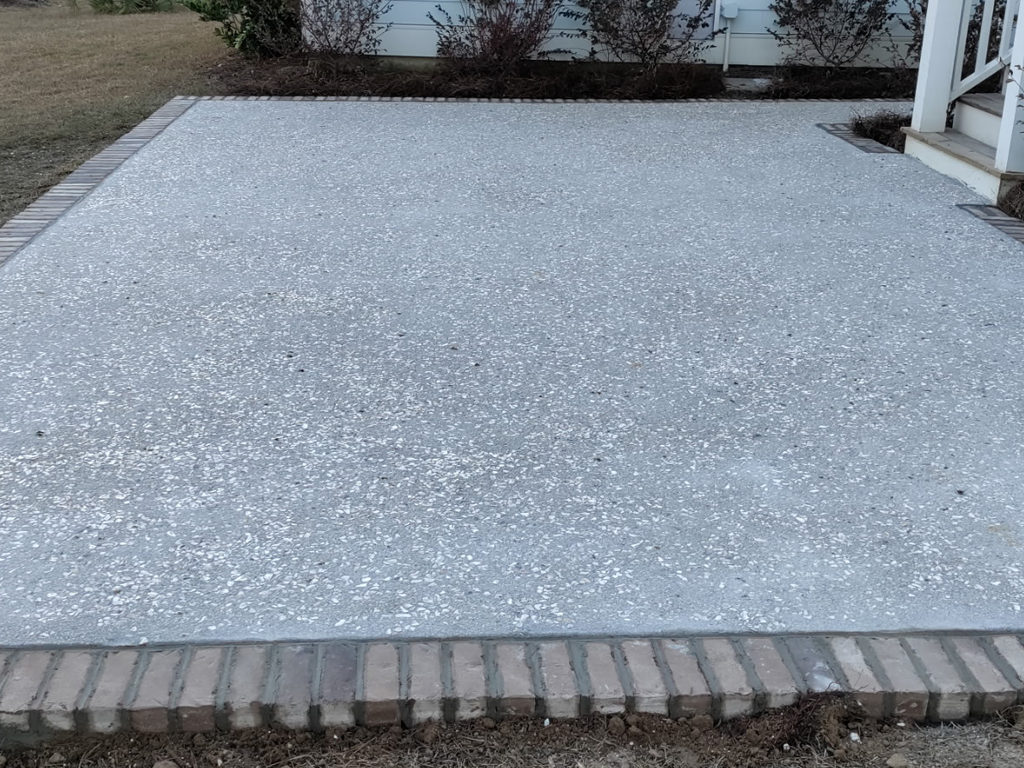
Today, Gorilla Concrete adapts the mix for modern use. We use oyster shells as aggregate in our concrete blends to achieve that classic Lowcountry look — while adding the reliability and strength of modern concrete techniques.
Tabby vs. Modern Concrete
Strength and Durability
Traditional tabby concrete is not as strong as modern portland cement concrete. However, it has proven its durability over centuries. Structures built with tabby in the 1700s are still intact today. That is a remarkable track record.
Modern concrete, by contrast, is engineered for high compressive strength. It cures faster and is easier to work with at scale. Therefore, for most residential and commercial projects, modern concrete is the practical choice.
Appearance
This is where tabby wins. Modern concrete has a clean, uniform look. Tabby concrete has character. The shell fragments, the rough texture, and the off-white color give it a warmth that plain concrete simply cannot match.
Consequently, many Charleston homeowners choose tabby-inspired finishes for patios, walkways, and decorative features. They want the aesthetic without sacrificing modern performance.
Cost and Availability
Traditional tabby requires sourcing shells, burning lime, and slow curing. That process is time-consuming and labor-intensive. As a result, pure tabby construction is rare today.
However, Gorilla Concrete offers a practical alternative. We incorporate crushed oyster shells into our concrete mixes to achieve a tabby-inspired finish. You get the Lowcountry look with the strength and speed of modern concrete.
Where You Can Still See Tabby Concrete in Charleston
Charleston and the surrounding area have some great examples of surviving tabby structures. Here are a few worth knowing about:
Middleton Place: The plantation grounds include tabby outbuildings that date back to the 18th century. The texture and color of the original material are still visible.
Fort Moultrie area structures: Several coastal fortifications and nearby buildings used tabby extensively. Some sections remain well-preserved.
Old slave quarters and plantation ruins: Many historic sites across the Lowcountry feature tabby remnants. These structures are an important part of understanding the region’s history.
Private historic homes: Some homeowners in Charleston’s historic districts still have original tabby foundations, walls, or paths on their properties.
When you see these structures, you are looking at the same basic material Gorilla Concrete references when clients ask us to incorporate a tabby finish into a modern project.
Can You Use Tabby Concrete on Your Property Today?
Yes — and it looks incredible. Tabby-inspired concrete works beautifully for a number of outdoor applications.
Patios and courtyards: The shell texture adds visual interest to outdoor living spaces. It fits perfectly with Charleston’s historic aesthetic.
Walkways and garden paths: Tabby-finish paths feel right at home next to older homes and lush Lowcountry landscaping.
Pool decks: The rough surface provides natural slip resistance, and the look pairs well with coastal outdoor spaces.
Decorative borders and accents: Even a tabby-finish border around a standard driveway can add a strong sense of place.
At Gorilla Concrete, we love working tabby-inspired finishes into modern projects. It is one of the ways we honor the Lowcountry’s building history while delivering concrete that performs at a modern standard.
If you are interested in a tabby finish for your next project, we would love to talk through the options.
Final Thoughts on Tabby Concrete
Tabby concrete is more than just a building material. It is a piece of this region’s story. From Spanish missionaries to colonial builders to the enslaved craftsmen who shaped so much of the Lowcountry, tabby runs through Charleston’s history like few other materials do.
Today, Gorilla Concrete keeps that tradition alive. We bring tabby-inspired finishes into modern projects because we believe great concrete should reflect where it is poured.
So, whether you are curious about the history or ready to add a Lowcountry touch to your next project, reach out to Gorilla Concrete. We have been pouring concrete in Charleston for over 15 years — and we know this place well.
Gorilla Concrete — Charleston-owned. Lowcountry-built.